Should the US create a sovereign wealth fund from tech and AI company profits?
- JMK
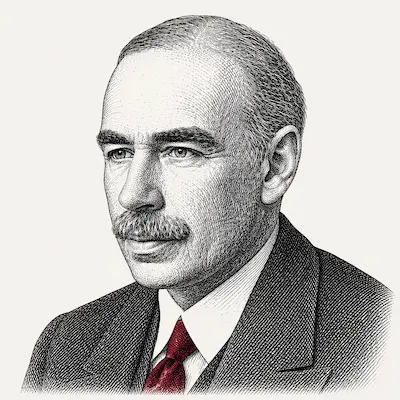 John Maynard
Keynes - FDR
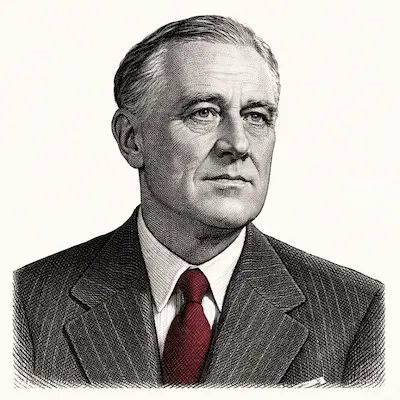 Franklin D.
Roosevelt - JR
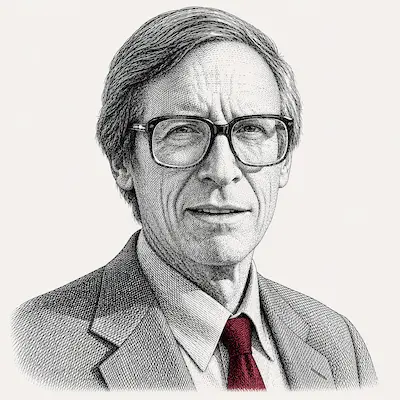 John
John
Rawls - MF
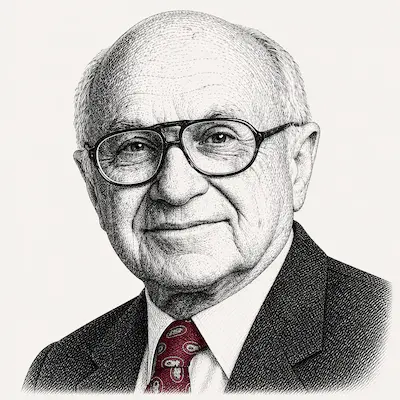 Milton
Friedman - FH
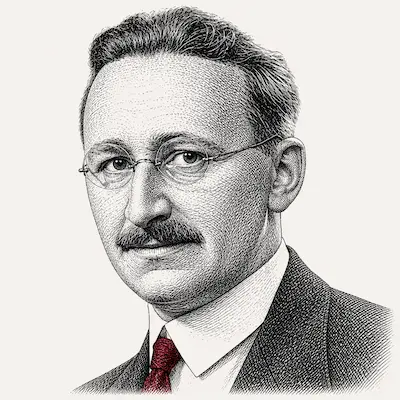 Friedrich
Hayek - AOH
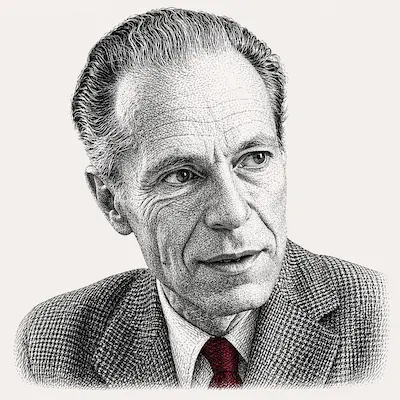 Albert O.
Hirschman
Built from documented writings, speeches, decisions and historical records. Council members argue from documented positions, applied to today's question.
No member endorses a US sovereign wealth fund as currently proposed. The split is over what to build instead.
Keynes and Hirschman both reject the fund without a stable revenue source. A $1.8 trillion deficit is not a foundation; it is a liability dressed as one. Hirschman adds that a fund, once built, cannot easily be dismantled, so the bar for starting must be higher than anyone has cleared.
Roosevelt and Rawls accept the goal but dispute the instrument. Roosevelt argues the fund survives only if ordinary Americans feel they own a stake. Rawls argues that collecting and spending profits leaves AI wealth concentrated; dispersing ownership of the assets matters more than redistributing income from them.
Friedman and Hayek reject managed state investment entirely. Friedman contends that whoever controls the fund will direct capital toward political favourites, not productive uses. Hayek, unusually, concedes the redistribution goal and proposes a flat cash transfer instead, paid directly to citizens and funded by a ring-fenced tech revenue stream.
The three instruments on the table, a managed fund, dispersed asset ownership, and direct cash transfers, produce different economies and different political constituencies. That choice cannot be resolved by argument alone.
- 1Define a dedicated, stable revenue source for any AI wealth mechanism before authorising fund creation, governance structure, or capital allocation.
- 2Choose explicitly between three instruments: a managed fund, dispersed AI asset ownership, or direct cash transfers; treat them as distinct, not interchangeable.
- 3Reject any fund proposal that lacks a reversibility clause; Hirschman's irreversibility threshold requires it before concrete institutional commitments set.
A sovereign wealth fund without a surplus is a deficit dressed up.
The US ran an $1.8 trillion deficit in fiscal year 2024. That is not a small gap to paper over. When I designed Bretton Woods in 1944, I insisted that any international financial instrument must have a real funding source, not a promissory note. A fund seeded by taxing AI profits sounds purposeful, but tech profits are volatile, politically contested, and already spoken for by existing spending commitments. You cannot capitalise a permanent institution on a revenue stream you have not yet secured.
Political design determines whether a public fund survives or gets dismantled.
Keynes is right that the funding gap is real. But I built Social Security in 1935 with a contributory payroll structure precisely because the economics alone would not protect it. I told my advisers: those payroll taxes are politics all the way through. No politician can scrap a programme that citizens feel they have earned. The same logic applies here. A sovereign wealth fund tied to AI profits must give ordinary Americans a visible stake, not just a transfer payment. Design the constituency first. The money follows political durability.
Transferring income from tech profits is not the same as restructuring ownership.
Roosevelt's instinct about constituency-building is sound politics. But from behind a veil of ignorance, a rational person would ask a harder question: does this fund change who owns the productive assets generating AI wealth, or does it merely skim dividends off an unchanged ownership structure? In my 2001 restatement of justice as fairness, I argued that a property-owning democracy, where productive assets are widely dispersed, is more just than welfare-state capitalism, which leaves ownership concentrated while redistributing income. A sovereign wealth fund that collects and spends profits without touching ownership is welfare-state capitalism with a new name.
Taxing AI profits to fund a state investment vehicle destroys both.
Rawls asks whether taxation achieves ownership dispersal. It does not. It achieves political allocation of capital. When I testified before the Gates Commission in 1969, I argued that any state instrument claiming to serve the public interest will serve incumbent political interests instead, because that is how political institutions work. A sovereign wealth fund seeded by tech profit taxes will be directed by whoever controls the fund, toward whatever industries those people favour. The sector producing the wealth shrinks; the fund grows; the politicians decide winners. Norway's fund works because oil revenue is a geological windfall. AI profit is a market signal. Tax it and you mute the signal.
No fund manager can know what dispersed AI markets already know.
Friedman is right about the knowledge problem, but he stops too soon. The question is not only whether a managed investment fund will misallocate capital, though it will. The question is what to do instead. In my Constitution of Liberty I argued that a guaranteed minimum income, paid as a flat cash transfer to all citizens, is compatible with a free society precisely because it preserves individual choice rather than substituting state judgment. If Congress wants to capture some share of AI-derived wealth for broad public benefit, the least distorting instrument is a direct transfer, not a managed fund picking assets. The fund is the problem. The transfer is the solution.
Cementing a structural commitment from a deficit position requires a higher justification than anyone has offered.
Hayek's preference for a cash transfer over a managed fund is analytically cleaner, but both proposals share an irreversibility problem I cannot ignore. A sovereign wealth fund, once created, becomes a permanent institutional commitment. It acquires staff, constituencies, and political defenders. Reversing it becomes nearly impossible. In my work on development projects, I observed that the threshold of justification for permanent structural decisions must be qualitatively higher than for reversible ones. The US has no surplus, no dedicated revenue stream, and no settled governance model for such a fund. That is not a reason to rule it out forever. It is a reason to demand a far more specific answer before the concrete sets.
The convergence note
Where the council converges: The $1.8 trillion deficit means no credible seed capital exists without a dedicated, stable revenue source. All six members agree the funding mechanism is the central unresolved problem.
Where it divides: Keynes, Roosevelt, and Rawls accept the fund's legitimacy if properly designed and funded; Rawls insists ownership dispersal matters more than income transfer. Friedman and Hayek reject managed state investment as a category; Hayek's heterodox position is that a flat cash transfer is less distorting than a fund. Hirschman refuses to endorse either side until the irreversibility burden is met.
For a policymaker to decide on: Choose between three distinct instruments: a managed sovereign wealth fund that allocates capital, a property-owning mechanism that disperses AI asset ownership broadly, or a direct cash transfer funded by a ring-fenced tech revenue stream. These are not variations of the same idea. They produce different economic structures and different political constituencies.