Built from documented writings, speeches, decisions and historical records. Council members argue from those positions, applied to today's question.
Tax capital gains like wages, fund universal basic services, and democratize ownership gradually through sovereign wealth funds.
Rawls and Sen agree that markets need rules to serve justice. Palme proved Sweden could compress inequality while boosting productivity from 1969 to 1976. Friedman's coordination mechanism works only when people can actually participate in markets.
Luxemburg and Friedman split on whether capitalism can be reformed or must expand through exploitation. The council agrees wealth concentration undermines the institutional trust that makes markets function.
- 1Tax capital gains at the same rate as wage income to reduce wealth concentration.
- 2Fund universal healthcare, education, and childcare through progressive taxation.
- 3Establish sovereign wealth funds that gradually democratize capital ownership.
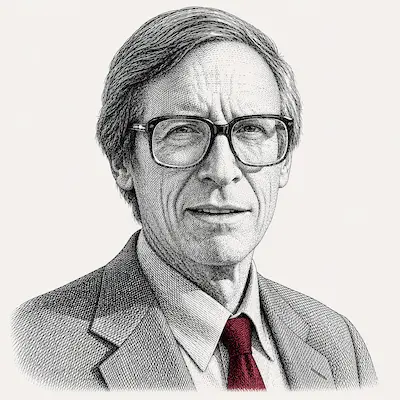
Just distribution requires ignorance of your own position.
Behind the veil of ignorance, rational persons would choose principles that protect them regardless of where they land in society. They would accept inequality only if it benefits the least advantaged. I developed this thought experiment in 1971 because utilitarian frameworks sacrifice individual justice for aggregate welfare. The difference principle follows necessarily: social and economic inequalities are justified only when they improve the position of society's worst-off members. This isn't charity or redistribution, it's what justice requires when we strip away the accidents of birth and circumstance.
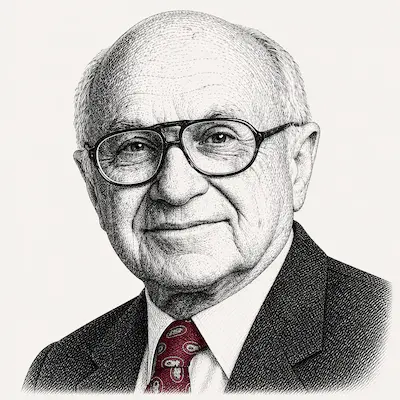
Free markets distribute according to value created, not political preference.
Rawls assumes we can design just outcomes, but markets don't distribute, they coordinate. When I advised Chile in 1975, I saw how price controls and state planning destroyed incentives faster than any inequality. The difference principle sounds fair until you ask: who decides what benefits the least advantaged? That decision requires knowledge no planner possesses. Markets let millions of people vote with their dollars about what they value. The result isn't designed to be just or unjust, it reflects what people actually produce and choose to exchange.
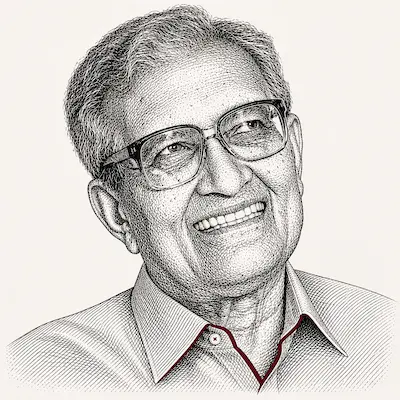
Distribution should expand what people can actually do and be.
Friedman's market outcomes ignore that people start with vastly different capabilities to participate. When I studied the 1943 Bengal famine, food was being exported while people starved, not because markets failed to coordinate, but because the poor lacked entitlement to buy food. Distribution isn't about income equality but capability equality: can people access healthcare, education, political participation? Markets are powerful tools, but they require institutional foundations. Democracy prevents famines not through market mechanisms but through public accountability when entitlements collapse.
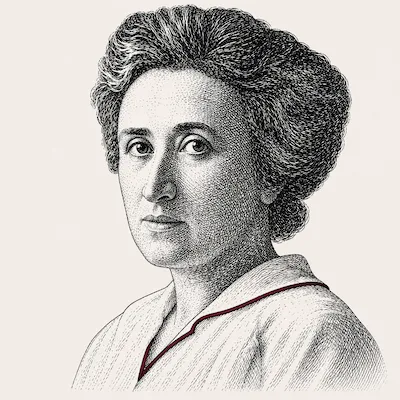
Capitalism distributes poverty systematically while concentrating wealth structurally.
Sen's capabilities approach misses the mechanism. In 1913 I demonstrated that capitalism requires continuous expansion into non-capitalist sectors to realize surplus value, it cannot reproduce itself on a purely capitalist base. The inequality Rawls wants to justify and the market coordination Friedman celebrates both depend on this imperial extraction. When I opposed German war credits in 1914, I saw how militarism serves accumulation. Distribution under capitalism isn't a policy choice, it's the outcome of property relations that concentrate ownership while socializing production costs.
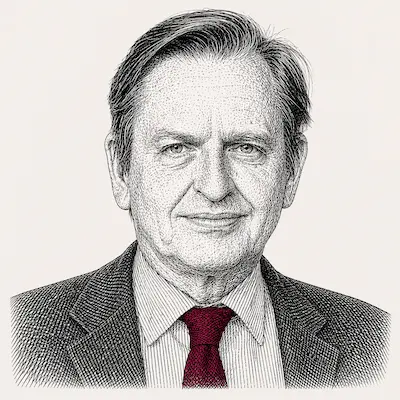
Equality builds the institutional trust that makes economies more productive.
Luxemburg underestimates what democratic institutions can achieve within capitalism. From 1969 to 1976, Sweden proved that universal social insurance, active labor market policy, and compressed wage differentials produce higher productivity, not lower. The Rehn-Meidner model delivered full employment with low inflation because equality creates the human capital and institutional quality that markets require. When I supported the Meidner Plan for wage earner funds, the goal was democratizing capital ownership gradually. Sweden's 1% development aid target shows how prosperity enables generosity, but only when distributed fairly first.
The convergence note
Where the council converges: Markets require institutional foundations to function well. Pure laissez-faire produces neither efficiency nor justice.
Where it divides: Whether capitalism's structural tendencies can be reformed through democratic institutions, or require replacement through revolutionary transformation.
For a policymaker to decide on: How much inequality to accept in exchange for growth, and whether that trade-off is real or false.