Built from documented writings, speeches, decisions and historical records. Council members argue from documented positions, applied to today's question.
Automation will concentrate wealth dangerously unless society redesigns who owns the machines.
Friedman wants competitive markets with income floors funded by productivity gains. Luxemburg demands workers control the automated systems they made possible. Prebisch insists developing countries need technology transfer, not market access. Ostrom proposes community ownership of local automated systems. Rawls calls for distributing capital shares directly to citizens.
All agree pure market distribution would create mass insecurity. None can be proven wrong about their alternative.
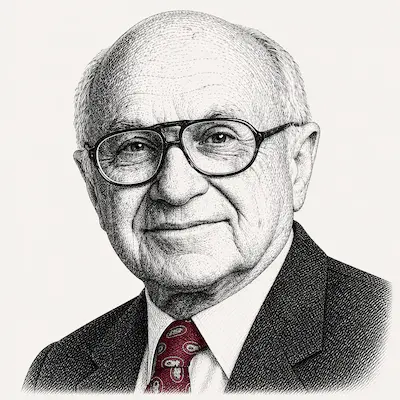
Markets distribute wealth more fairly than any alternative when everyone can participate.
In 1962 I argued that economic freedom and political freedom are inseparable. Automation changes the scale but not the principle. When machines produce abundance, the question becomes: who owns the machines? Under private ownership with competitive markets, automation reduces costs and prices fall. Real wages rise even if employment shifts. The displaced worker becomes the beneficiary of cheaper goods. This happened with every previous wave of mechanization from textiles to automobiles.
The negative income tax I proposed in 1962 solves the employment problem directly. Fund it with automation's productivity gains through a progressive consumption tax. Everyone receives a basic income floor. Those who work earn more. Those who choose leisure or retraining receive dignity without bureaucratic interference. Markets determine which human services remain valuable. Government provides the safety net. Individual choice drives the allocation.
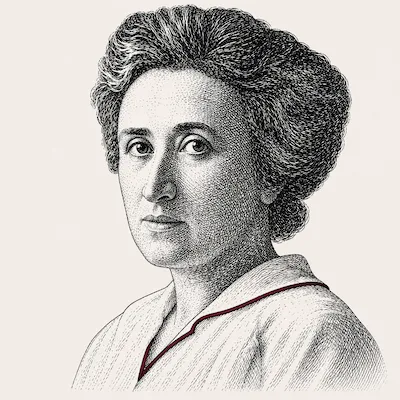
Automation under private ownership produces abundance for the few and insecurity for the many.
Friedman assumes competitive markets will distribute automation's gains broadly. But automation concentrates productive capacity in fewer hands than any previous technology. His negative income tax preserves the fundamental relationship: a small class owns the productive apparatus while the majority depends on transfers. This reproduces capitalism's core contradiction at a higher technological level. In 1913 I showed how capitalism requires continuous expansion into new markets to realize surplus value. When automation eliminates the need for most human labor, where are the new markets?
The democratic ownership of automated production is not a planning problem but a political one. Workers who built the factories, engineers who designed the systems, communities that educated the workforce — they created the conditions that made automation possible. Private appropriation of collectively created wealth is theft, whether the machines are steam-powered or artificially intelligent. The calculation problem applies to central planning, not to democratic control by those who depend on the system's output.
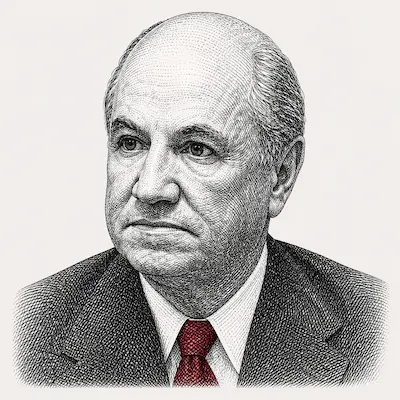
Automation will deepen global inequality unless developing countries control the technology.
Luxemburg grasps the international dimension Friedman ignores. Automation technologies are developed in advanced economies and exported to the periphery on terms set by the center. This reproduces the terms-of-trade deterioration I documented in 1950, but in reverse. Instead of primary commodities becoming cheaper relative to manufactured goods, human labor becomes worthless relative to automated production. Countries that cannot afford automation become permanently dependent on those that can.
In the 1960s I saw how import substitution failed when countries lacked the technological capacity to compete. Automation requires the same response at global scale. Developing countries need technology transfer agreements, not market access. They need the right to reverse-engineer automated systems, not intellectual property protection. They need international financing for automation infrastructure, not debt service to countries that automated first.
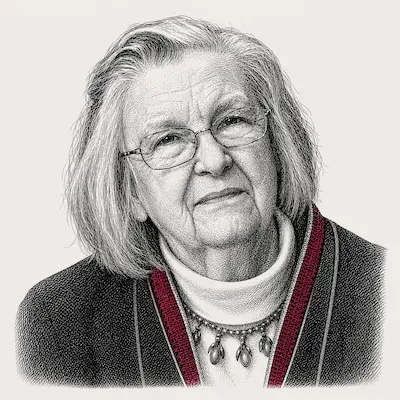
Automation governance requires community control over systems that serve community needs.
Prebisch correctly identifies the concentration problem, but his state-centered solution misses the institutional innovation automation enables. Automated systems can be governed as commons — shared productive resources managed by the communities that depend on them. This is neither Friedman's private ownership nor Luxemburg's revolutionary seizure. It is polycentric governance adapted to automated production.
My eight design principles apply directly. Automated systems need clearly defined user communities, rules matched to local needs, collective choice in system management, effective monitoring of performance, graduated responses to system failures, conflict resolution mechanisms, and recognition by external authorities. A neighborhood that owns its automated food production system, a region that governs its transportation grid, a city that manages its energy commons — these are institutional innovations, not planning problems.
Justice requires that automation's gains improve the position of the worst-off members of society.
Ostrom's polycentric approach is promising but insufficient for the scale of automation's impact. Behind the veil of ignorance, not knowing whether you would be a skilled engineer, a displaced factory worker, or someone born into poverty, what distribution system would you choose? You would choose arrangements that maximize the position of the least advantaged — because you might be among them.
This suggests a property-owning democracy rather than welfare-state capitalism. Instead of Friedman's negative income tax, distribute ownership of automated capital directly. Every citizen receives a share in the automated productive capacity. This is not redistribution of income but predistribution of wealth. The difference principle permits inequality in automated systems only if those inequalities benefit the least skilled, least connected, least advantaged members of society.
The basic structure must be designed so that automation serves justice, not efficiency alone. Markets can operate within this framework, but the framework itself must be chosen from the original position.
The convergence note
Where the council converges: All members agree that pure laissez-faire distribution of automation's gains would concentrate wealth and create mass economic insecurity.
Where it divides: Friedman trusts markets with safety nets. Luxemburg demands democratic ownership. Prebisch requires international technology transfer. Ostrom favors community governance. Rawls insists on predistribution of capital ownership.
For a policymaker to decide on: Whether to distribute automation's gains through income transfers, ownership shares, community control, or international agreements — and at what scale.