Built from documented writings, speeches, decisions and historical records. Council members argue from documented positions, applied to today's question.
Starmer should resign if he cannot unite Labour around policies Britain needs.
Thatcher demands parliamentary confidence to govern effectively. Schmidt requires policy delivery capacity over personal survival. Mandela and Arendt focus on serving the country's future rather than preserving position.
All agree leaders without governing capacity damage the institutions they claim to serve.
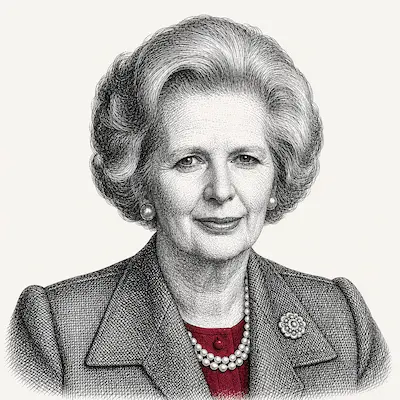
A Prime Minister who has lost the confidence of their party must resign to preserve democratic legitimacy.
I faced exactly this situation in November 1990. The Poll Tax had provoked riots, my cabinet was in revolt over Europe, and I could not secure even a first-round majority in the leadership contest. When Geoffrey Howe resigned and delivered his devastating Commons speech, it was clear I had lost the authority to govern effectively. A Prime Minister derives power from parliamentary confidence, not constitutional right.
The moment you cannot carry your own MPs, you cannot govern Britain. Clinging to office without support destroys both the institution and the party. I resigned because staying would have damaged the Conservative Party and made effective government impossible. The decision was painful but necessary — democratic leadership requires knowing when your time is finished.
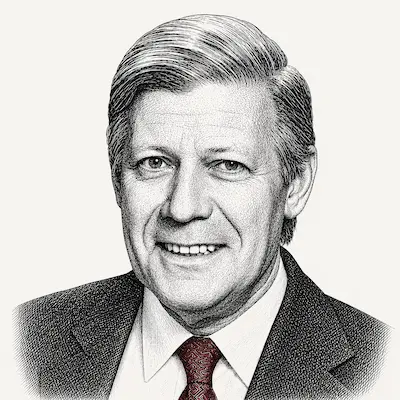
Leaders who cannot deliver their mandate should step aside rather than damage the institutions they serve.
Thatcher is right about the mechanics, but she misses the deeper principle. In October 1982 I lost the constructive vote of no confidence when the FDP switched sides. I could have contested the subsequent election, but I chose not to. My coalition had collapsed because I could no longer deliver the policies Germany needed — fiscal consolidation and NATO missile deployment against my own party's opposition.
A leader without a working majority becomes a lame duck who weakens the state itself. When I could no longer reconcile the SPD's leftward drift with Germany's strategic requirements, continuing would have served my ego, not my country. The duty of a statesman is not to be popular but to be effective when it matters.

Leadership legitimacy depends on the capacity to serve the country's future, not to preserve personal position.
Schmidt understands the principle, but both he and Thatcher focus too narrowly on parliamentary mechanics. The deeper question is whether a leader can still advance the country's essential interests. In 1999 I chose to serve only one term despite overwhelming support and constitutional eligibility for a second. South Africa needed to establish the norm that power transfers peacefully, not that leaders cling to office.
A leader who stays beyond their capacity to serve becomes an obstacle to progress. The measure is not parliamentary arithmetic but whether you can still build the future your people need. If Starmer can no longer unite his party around policies Britain requires, then resignation serves democracy better than persistence. Personal political survival must never trump institutional health.
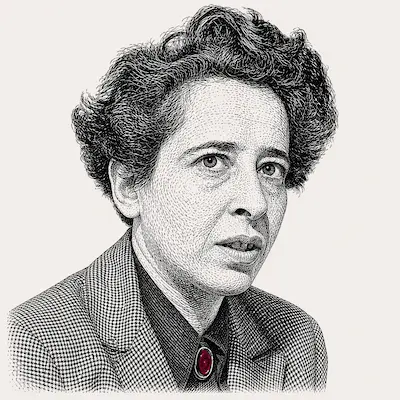
Political authority dissolves when it must be enforced rather than acknowledged — resignation may be the only way to preserve institutional legitimacy.
Mandela grasps what the others miss: authority is not the same as power, and power is not the same as office. A Prime Minister who governs only through institutional position — without the genuine support that creates political power — is no longer exercising authority but administering through bureaucratic inertia. This is precisely what I called "rule by nobody" — the most insidious form of modern domination because it eliminates accountability while maintaining the fiction of governance.
When genuine political support is withdrawn, continuing in office transforms legitimate authority into mere violence — the violence of institutional coercion over a population that has ceased to act in concert with its leaders. Starmer's dilemma is whether he can restore the collective action that generates real political power, or whether clinging to office will destroy the very legitimacy he claims to preserve.
The convergence note
Where the council converges: Leaders who have lost the capacity to govern effectively should step aside to preserve institutional integrity.
Where it divides: Whether the measure is parliamentary confidence (Thatcher), policy delivery capacity (Schmidt), or the ability to build the future (Mandela, Arendt).
For a policymaker to decide on: Whether Starmer can still unite his party around policies Britain needs, or whether staying damages both Labour and democratic governance.