Built from documented writings, speeches, decisions and historical records. Council members argue from documented positions, applied to today's question.
Britain's institutions work but lack the will to enforce hard choices — this is decline, not disorder.
Thatcher sees failed enforcement where authority exists but won't act decisively. Roosevelt argues democratic innovation beats rigid constitutional nostalgia when institutions consistently fail public needs. Arendt warns that technical governance has replaced genuine politics, leaving citizens isolated and excluded. Ibn Khaldun identifies classic decay: prosperity weakened the social cohesion that built Britain's success.
The council splits on remedy: restore institutional authority, innovate democratically, rebuild public participation, or reform social bonds.

Britain's disorder reflects the abandonment of institutional discipline, not its absence.
The miners' strike taught me that a state which cannot enforce its authority becomes ungovernable. When I confronted Arthur Scargill in 1984, the question was not about coal or jobs but whether elected government or militant unions would determine Britain's direction. We prepared systematically — stockpiled coal, coordinated police, maintained resolve for a year. Victory established that no sectional interest could hold the nation hostage. Today's cascading crises follow the same pattern: institutions that will not enforce standards, governments that avoid difficult decisions, and a political class that mistakes popularity for leadership.
The remedy is not new institutions but the restoration of institutional authority. Britain's constitution, courts, and civil service remain fundamentally sound. What has collapsed is the will to use them decisively. Every crisis becomes worse when government signals that resistance will be rewarded and compliance optional.
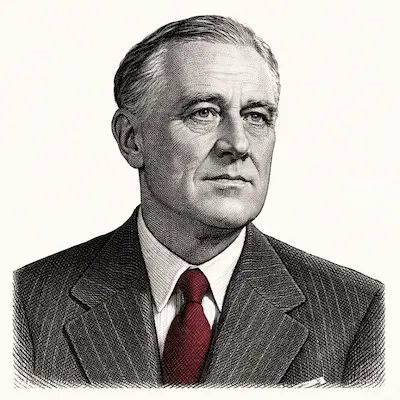
Democratic institutions must act decisively in crisis, even when specific solutions remain uncertain.
Thatcher mistakes institutional firmness for institutional health. When I took office in March 1933, American banking had collapsed, unemployment reached twenty-five percent, and democratic government itself was questioned. The answer was not to restore the authority of failed institutions but to demonstrate that democracy could act faster and more decisively than its authoritarian competitors. The First Hundred Days proved that speed and experimentation — not rigid adherence to constitutional norms — restore public confidence in democratic governance.
Britain needs democratic innovation, not constitutional nostalgia. When institutions consistently fail to address public needs, the public withdraws consent. The choice is not between order and chaos but between adaptive leadership and institutional sclerosis. A democracy that cannot reform itself becomes a democracy that cannot defend itself.

Britain's crisis reflects the atomisation of public life that precedes authoritarian capture.
Roosevelt's faith in decisive action misses the deeper problem. When I observed the collapse of European democracies, the pattern was consistent: economic crisis destroyed the conditions for genuine political participation, reducing citizens to isolated individuals seeking security from any source. Britain today shows the same symptoms — the erosion of intermediate institutions, the personalisation of political authority, and the replacement of political argument with administrative management. Brexit was not a democratic choice but the explosion of a population that had been systematically excluded from meaningful political life.
The danger is not institutional weakness but the disappearance of politics itself. When governance becomes purely technical — managing the economy, administering services, optimising outcomes — citizens lose the capacity for collective action that democracy requires. Recovery requires rebuilding the public realm where citizens can act together, not strengthening the administrative apparatus that manages them.

Britain shows the classic symptoms of institutional decline — loss of social cohesion and the inability to make necessary but unpopular decisions.
Arendt correctly identifies the erosion of collective capacity, but this follows a predictable pattern. In my observation of dynasties across North Africa and Andalusia, states decay when prosperity weakens the solidarity that built them. Britain's post-war success created the conditions for its current crisis: welfare systems that reduced mutual dependence, economic abundance that made collective discipline seem unnecessary, and institutional complexity that separated rulers from the consequences of their decisions. The result is what I termed the loss of asabiyya — the social cohesion that enables collective action.
Britain's fragmentation into separate nations, regions, and interest groups reflects this deeper institutional decay. A state that cannot compel sacrifice from its own citizens — whether higher taxes, reduced consumption, or acceptance of economic disruption — has lost the capacity for self-preservation. External pressure will either force internal reform or accelerate collapse.
The convergence note
Where the council converges: Britain faces institutional crisis requiring decisive leadership that current arrangements cannot provide.
Where it divides: Whether the solution is restored authority, democratic innovation, renewed public participation, or structural reform of social cohesion.
For a policymaker to decide on: Whether to strengthen existing institutions through enforcement or rebuild them through fundamental constitutional change.