Built from documented writings, speeches, decisions and historical records. Council members argue from those positions, applied to today's question.
European nuclear capacity would either strengthen Europe's alliance position or destroy the security architecture that has protected it for seventy years.
Schmidt and de Gaulle argue American guarantees fail when vital interests diverge. Trump's return validates their concern that Washington's commitment depends on Washington's politics. An EU deterrent would give Europe independent options when alliance consultation breaks down.
Thatcher and Adenauer counter that proven NATO arrangements already provide credible deterrence through multiple overlapping guarantees. EU nuclear weapons would signal American dispensability and invite the withdrawal that makes Europe less secure, not more.
The split turns on whether European strategic autonomy strengthens or undermines transatlantic cooperation under great power competition.
- 1Maintain NATO's existing nuclear arrangements while strengthening European conventional capabilities within the alliance framework.
- 2Reject any EU nuclear development that signals American dispensability or competes with proven deterrence structures.
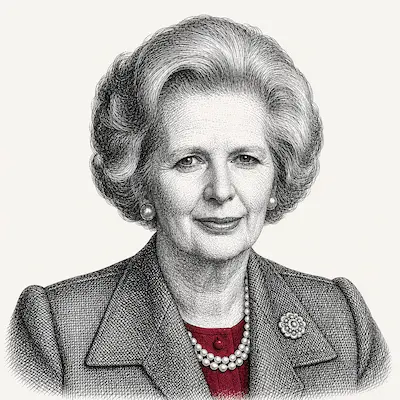
EU nuclear weapons would undermine the alliance that guarantees European security.
The Soviet threat taught us that deterrence works through credible commitment, not institutional complexity. NATO's nuclear architecture, American extended deterrence, British and French independent forces, nuclear sharing arrangements, has kept the peace for seventy years. An EU nuclear capability would create dangerous ambiguity about command authority, duplicate existing deterrence, and signal to Washington that Europe no longer values the Atlantic alliance. Germany's hosting of US nuclear weapons demonstrates that sovereignty and alliance interdependence strengthen each other when properly structured.

European nuclear capability would destabilise the alliance structures that guarantee European security.
Thatcher grasps the essential point: our security rests on proven arrangements, not theoretical improvements. In 1954 I accepted German rearmament within NATO because I understood that European security required American engagement, not European self-sufficiency. An EU nuclear force would signal American dispensability and invite American withdrawal. The French deterrent exists within NATO's broader framework; an EU capability would compete with it. We built European integration to strengthen the Western alliance, not replace it.

European states cannot rely on American nuclear guarantees when vital interests diverge.
Adenauer mistakes alliance management for strategic dependence. I withdrew France from NATO's integrated command precisely because American nuclear decisions serve American interests, not European ones. Would Washington risk New York for Hamburg? The question answers itself. France's independent deterrent ensures that no external power, ally or adversary, can dictate French survival. An EU nuclear capability is the logical extension: European vital interests require European strategic autonomy. Alliance with America, yes; dependence on America, no.

European strategic autonomy requires European nuclear capability as American commitment becomes unreliable.
De Gaulle anticipated what I experienced: American security guarantees are conditional on American interests. The neutron bomb reversal taught me that Washington's word depends on Washington's politics. An EU nuclear capability would not replace NATO but strengthen Europe's position within it. The Double-Track Decision succeeded because Europe could credibly threaten independent action. Nuclear sharing arrangements leave Germany dependent on American decisions about German territory. European strategic autonomy means European capacity to act when alliance consultation fails.
The convergence note
Where the council converges: All members accept that nuclear deterrence remains necessary for European security in an unstable world.
Where it divides: Thatcher and Adenauer defend existing NATO arrangements as proven and sufficient. De Gaulle and Schmidt argue American reliability has structural limits requiring European alternatives.
For a policymaker to decide on: Whether European strategic autonomy strengthens or weakens transatlantic security cooperation under conditions of renewed great power competition.