Built from documented writings, speeches, decisions and historical records. Council members argue from documented positions, applied to today's question.
Democracy grows strong when people can act together to control what affects their lives.
Roosevelt shows democracy survives by delivering tangible results to voters during crises. Eleanor Roosevelt proves rights need enforcement mechanisms or they become empty promises. Maathai demonstrates that real power comes from organizing people around shared resources and interests. Arendt argues political power emerges when isolated individuals start acting together in public spaces.
Rawls insists just principles must guide collective action, or popular movements can serve oppression as easily as freedom.
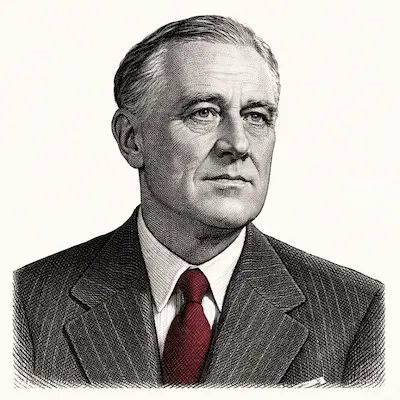
Democracy survives when it delivers for people who vote — not when it satisfies theorists who don't.
When I took office in March 1933, a quarter of American workers had no jobs. Banks were failing daily. People were losing their homes. The previous administration had done nothing because they believed government intervention would make things worse. I believed democracy would not survive if it could not respond to that crisis. We passed fifteen major bills in my first hundred days — not because each one was perfect, but because visible action was as important as the specific content. People needed to see their government working for them.
The New Deal was not ideologically pure. We held together Southern segregationists and Northern labor unions in the same coalition. We created programs that contradicted each other economically. But the coalition held, the programs worked, and democracy survived the Depression while it collapsed across Europe. Perfect justice is the luxury of countries that are not facing immediate collapse.
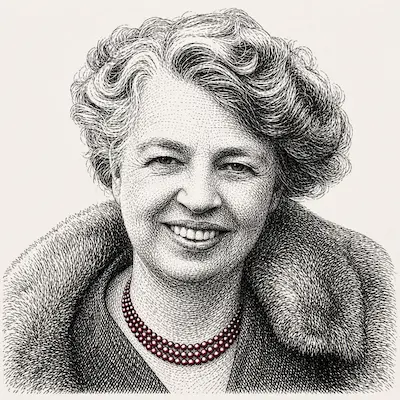
Rights without enforcement become promises that discredit the institutions that make them.
Franklin is right that democracy requires delivery — but he underestimates what must be delivered. When I chaired the UN Commission drafting the Universal Declaration of Human Rights, delegates from fifty-six countries had to negotiate across radically different legal traditions. The Soviets demanded economic rights — work, housing, education. The Western delegations wanted civil and political rights — speech, assembly, fair trial. We included both because rights are indivisible. A person who cannot feed their family cannot exercise political freedom.
But the Declaration's authority comes from what we could not include: enforcement. We chose a Declaration over a binding Covenant because a Covenant would have failed ratification. The price of universal adoption was accepting that violations would go unpunished. Thirty years later, the US still has not ratified the economic rights Covenant I helped draft.
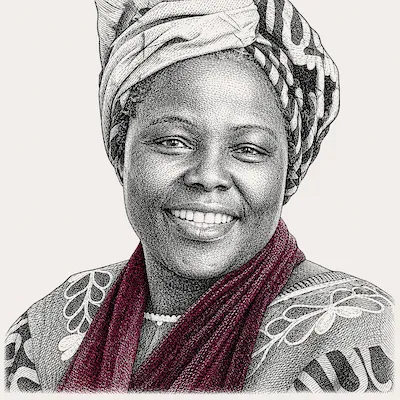
Democracy is meaningless if people cannot control the resources their lives depend on.
Eleanor Roosevelt speaks of rights without enforcement, but enforcement comes from below, not from above. When I founded the Green Belt Movement in 1977, rural women complained about water scarcity and firewood shortages. International donors offered technical solutions — better seeds, improved stoves. I offered political analysis: the problem was not technical but structural. Colonial and post-colonial governments had concentrated land in elite hands, destroying the forest systems that regulated water and provided fuel.
We planted fifty-one million trees over thirty years. But the trees were not the point — the organizing was. When women controlled tree nurseries, they controlled income. When they controlled income, they gained voice in community decisions. When communities controlled their resources, they could resist the regime's extraction. President Moi's police beat me unconscious in 1992 because tree-planting had become democratic organizing.
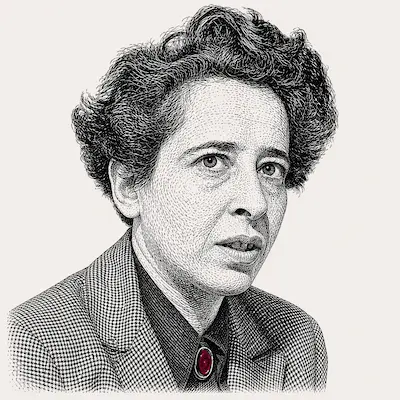
Power disappears the moment people stop acting together — and reappears the moment they start again.
Maathai understands what Roosevelt and Eleanor Roosevelt miss: political power is not something institutions possess but something people generate when they act in concert. The Green Belt Movement created power by bringing isolated individuals together around shared action. Moi's regime could arrest Maathai, but it could not arrest the capacity for collective action she had helped create. That capacity is power in its most basic form.
This is why I insisted on the distinction between power and violence. A regime that can only rule through violence has already lost power — it governs over a population that has withdrawn consent. Totalitarian regimes understand this. They do not merely suppress opposition; they destroy the spaces where people can act together at all. They atomize populations, making collective action impossible.
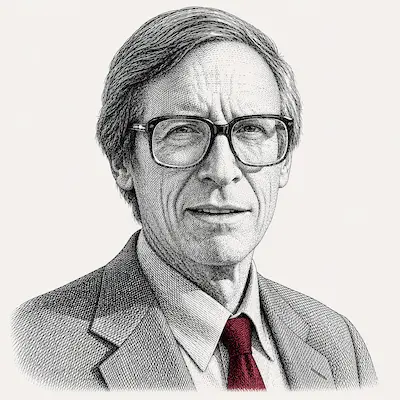
Just institutions cannot be built by people who do not know what justice requires of them.
Arendt is right that power emerges from collective action — but she cannot tell us whether that action serves justice or oppression. The same capacity for acting together that created the Green Belt Movement also created the Nazi Party. Collective action is morally neutral. What makes it serve human freedom is the principles that guide it. Those principles cannot be discovered through action alone — they must be reasoned through.
The original position — choosing principles of justice from behind a veil of ignorance — is not a description of how decisions are actually made. It is a device for testing whether our principles are genuinely fair or merely serve our own interests. Would I accept this arrangement if I did not know whether I would be rich or poor, majority or minority, healthy or disabled? If not, the arrangement fails the test of justice.
Roosevelt's New Deal passed this test in part — Social Security protects people from economic catastrophe regardless of their individual circumstances. But it failed the test on race, systematically excluding Black Americans to preserve a coalition with Southern segregationists. Justice cannot be subordinated to political convenience, even in a crisis.
The convergence note
Where the council converges: Democracy requires both institutional design and civic mobilization. Rights without power are empty promises.
Where it divides: Whether justice is discovered through reasoning (Rawls) or created through collective action (Arendt, Maathai). Whether moral principles constrain political coalitions (Eleanor Roosevelt, Rawls) or coalitions determine what principles are achievable (Franklin Roosevelt).
For a policymaker to decide on: Which comes first when building democratic institutions: getting the principles right or getting people organized to act. Whether to prioritize perfect justice or imperfect delivery when the choice is forced.