When debt grows, why do governments choose to print money — and how does that shape the debt cycle?
Built from documented writings, speeches, decisions and historical records. Council members argue from documented positions, applied to today's question.
Governments print money because the political cost of fiscal adjustment arrives in months while inflation arrives in years.
Friedman and Keynes agree politicians face immediate pressure when debt service threatens operations. Schmidt points to the Federal Reserve's $4.2 trillion expansion as institutional failure where German central bank independence succeeded. Ibn Khaldun frames Japan's 260% debt ratio as dynastic decline disguised as policy success.
The council splits on whether crisis justifies expansion or reveals state weakness that printing accelerates.
- 1Restore central bank independence to prevent political control over monetary expansion decisions.
- 2Publish annual debt sustainability thresholds that trigger automatic fiscal adjustment before monetary financing.
- 3Replace crisis-driven monetary policy with predetermined rules that survive political transitions.

Governments print money because politicians survive crises, not consequences.
Politicians face immediate pressure when debt service threatens government operations. The political cost of fiscal adjustment, cutting spending, raising taxes, arrives within months. The cost of monetary expansion, inflation, currency debasement, arrives years later, often under a different administration. In 1979 I advised the Federal Reserve that allowing money supply to collapse was the mistake of the 1930s. But printing to avoid fiscal discipline creates the conditions for larger future crises. The $4.2 trillion expansion since 2020 demonstrates the pattern: crisis justifies expansion, expansion creates dependency, dependency demands more expansion.
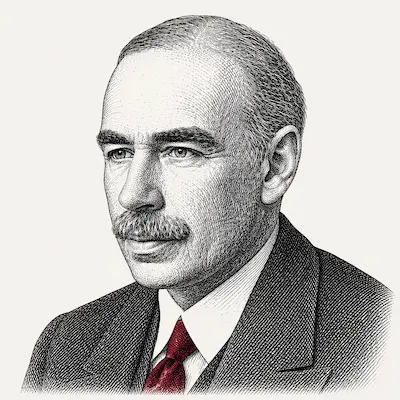
Under genuine uncertainty, monetary expansion may be the least-bad option.
Friedman mistakes the choice governments actually face. When debt service consumes 13% of the federal budget and bond markets threaten to freeze, the alternative to monetary expansion is not fiscal rectitude. It is economic collapse. In 1940 I designed compulsory savings to finance war without inflation because the alternative was losing the war. Japan's 260% debt-to-GDP ratio with near-zero yields proves that markets will accept monetary expansion when the alternative is systemic breakdown. The long run matters only if you survive the short run. Animal spirits drive markets more than monetary theory.

Debt monetisation destroys the price system that enables rational calculation.
Keynes ignores what monetary expansion actually does. Prices are not mere numbers, they aggregate dispersed knowledge about relative scarcity and value. When central banks create money to purchase government debt, they sever the connection between price signals and underlying reality. I witnessed this in 1920s Vienna, where currency debasement made economic planning impossible for businesses and families alike. Japan's zero yields do not prove market acceptance; they prove market distortion. When government bonds yield nothing, the market is no longer pricing risk. It has stopped functioning as a market entirely.

Independent central banks exist precisely to prevent this choice.
Hayek identifies the problem but misses the institutional solution. In 1981 I publicly pressured the Bundesbank to lower rates during recession. They refused. I accepted their refusal because the Bundesbank's independence was more valuable than my political convenience. The Federal Reserve's $4.2 trillion expansion happened because American institutions failed where German ones succeeded. When politicians control monetary policy directly, they always choose the immediate benefit over the long-term cost. Central bank independence is not a constraint on government. It is a constraint on bad government. The question is not whether to print money, but who decides.

Debt-driven monetary expansion signals dynastic decline, not economic necessity.
Schmidt's institutional solution assumes the dynasty remains strong enough to respect its own constraints. When rulers debase currency to finance expenditure, they reveal that the productive base no longer supports their ambitions. I observed this pattern across multiple North African dynasties: taxation rises, revenue falls, currency debasement follows, and the dynasty collapses within a generation. The Federal Reserve's expansion and Japan's zero yields are symptoms of the same decay. A state that cannot finance itself through taxation has lost the asabiyya that enabled its rise. Printing money accelerates the cycle toward collapse rather than preventing it.
The convergence note
Where the council converges: All agree that monetary expansion to finance debt creates long-term risks. The mechanism is political addiction to short-term solutions.
Where it divides: Keynes sees crisis management necessity. Friedman sees systematic policy error. Hayek sees knowledge destruction. Schmidt sees institutional failure. Ibn Khaldun sees dynastic decay.
For a policymaker to decide on: Whether current debt levels justify the inflation risk, and what institutional constraints can make that choice reversible.