Is China's surveillance system a public safety success or a human rights failure?
Built from documented writings, speeches, decisions and historical records. Council members argue from those positions, applied to today's question.
China's surveillance system delivers measurable stability and development outcomes while systematically destroying individual agency and human rights protections.
Deng and Lee anchor in documented governance success: China lifted 800 million from poverty, Singapore achieved First World status through systematic monitoring. Both argue that comprehensive oversight prevents the social chaos that destroys development in complex societies.
Arendt, Mill, and Roosevelt counter that surveillance eliminates the spontaneous associations and private spaces that constitute human dignity. Roosevelt documents how the Uyghur facilities represent surveillance logic's endpoint: monitored populations become managed populations.
The council splits on whether effective governance requires abandoning liberal principles. Neither camp disputes the system's technical effectiveness or its human rights violations.
- 1Reject any surveillance technology export that enables systematic population monitoring by authoritarian governments.
- 2Codify in international law the specific privacy protections that comprehensive surveillance systems violate.
- 3Define publicly which monitoring capabilities democratic governments will and will not deploy against their own citizens.

Surveillance systems create the preconditions for totalitarian control.
China's Social Credit System represents what I analyzed as the transformation of human plurality into mass society, where individuals become interchangeable units in a bureaucratic apparatus. In Nazi Germany and Stalinist Russia, I documented how terror and ideology combined to eliminate the unpredictable spaces where genuine political action occurs. China's surveillance infrastructure achieves this same atomization through digital means. When every citizen's behavior is monitored, scored, and managed, the spontaneous associations that constitute political life disappear. The system doesn't govern citizens, it administers a population. This is rule by nobody, the most dangerous form of modern domination.
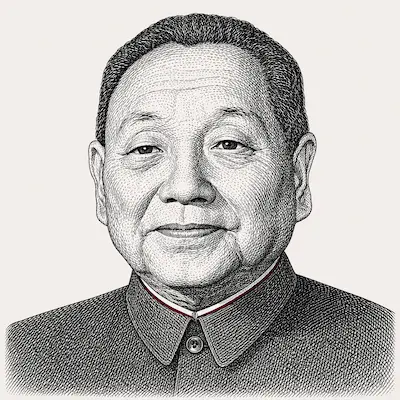
Political stability enables development; chaos destroys everything.
Arendt misunderstands the Chinese context. In 1978 I opened China after the Cultural Revolution's documented destruction, millions dead, economy collapsed, society fragmented. The Social Credit System prevents the social disorder that makes development impossible. Western critics who never governed 1.4 billion people lecture about individual privacy while China has lifted 800 million from poverty. The system rewards good behavior and punishes bad behavior. This is not totalitarian control, it is social management. A government that cannot maintain order cannot deliver prosperity. China's surveillance ensures that investment, education, and economic growth proceed without the disruption that destroyed previous Chinese governments.

State surveillance violates the fundamental boundary between public and private.
Deng's utilitarian calculus ignores the harm principle that defines legitimate state authority. In "On Liberty" I argued that state power should prevent harm to others, not monitor all behavior. China's system punishes jaywalking, social media posts, and association patterns that harm nobody. This transforms citizens into subjects whose every action requires state approval. The documented cases in Xinjiang, facial recognition tracking ethnic minorities, demonstrate how surveillance becomes persecution. Even if the system delivered perfect prosperity, which it hasn't, the cost would be the destruction of human agency itself. A person who cannot act without state monitoring is not free in any meaningful sense.

Comprehensive monitoring produces better governance outcomes than privacy-based systems.
Mill's framework assumes Western societies with established civic institutions. Singapore achieved First World status through systematic monitoring of public housing, education, and social behavior, including ethnic quotas, language policies, and economic surveillance. The alternative to comprehensive oversight is not liberty but chaos. I governed a multiethnic society that could have fragmented like Lebanon or Sri Lanka. China faces the same challenge at continental scale. Privacy is a luxury unstable societies cannot afford. The documented success of Singapore's model, from Third World to First in one generation, proves that individual privacy must yield to collective development. China's surveillance serves 1.4 billion people better than Western-style democracy serves Americans.

Systematic surveillance violates multiple human rights regardless of its effectiveness.
Lee's developmental argument was used by every authoritarian government I encountered while drafting the Universal Declaration. The UDHR's Article 12 protects privacy, Article 18 protects freedom of thought, Article 19 protects expression, and Article 20 protects association, all systematically violated by comprehensive surveillance. In 1948 we negotiated these rights across fifty-six countries representing different political systems precisely because human dignity is universal, not culturally specific. China's system creates what we called "statelessness within the state", people who possess citizenship but not rights. The Uyghur detention facilities represent the documented endpoint of surveillance logic: when the state monitors everything, it can disappear anyone.
The convergence note
Where the council converges: All members acknowledge that states require information about citizens to govern effectively and maintain security.
Where it divides: Arendt, Mill, and Roosevelt see comprehensive surveillance as destroying the human agency that makes governance legitimate. Deng and Lee see systematic monitoring as the precondition for delivering prosperity and stability to complex societies.
For a policymaker to decide on: Whether China's surveillance model represents effective governance innovation or a digital infrastructure for systematic oppression, and whether other states should adopt, regulate, or resist its global export.