Built from documented writings, speeches, decisions and historical records. Council members argue from documented positions, applied to today's question.
Israel has no legal right to build settlements, but the council splits on whether security threats override international law.
Ben-Gurion frames survival as preceding law when facing existential threat from the West Bank highlands. Roosevelt anchors in the UN framework created after two world wars: security exceptions destroy the system protecting everyone. Fanon identifies settlements as colonial domination that creates permanent Palestinian subjugation under military rule.
Machiavelli breaks from security justifications: sixty years of settlement policy has failed to pacify territory or eliminate enemies.
- 1Reject settlement expansion that fails to achieve either complete territorial pacification or strategic withdrawal.
- 2Enforce Fourth Geneva Convention prohibitions on population transfer to occupied territory without security exceptions.
- 3Define clear conditions under which temporary military occupation transitions to either sovereignty or withdrawal.
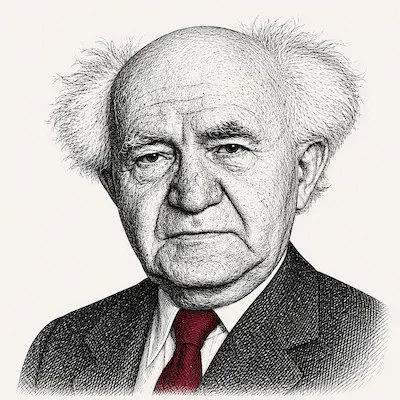
Security requirements justify settlement when facing existential threat.
In May 1948 I declared independence knowing Arab armies would invade immediately. The choice was statehood with war or no statehood at all. Today's settlements in Area C follow the same logic: Israel cannot survive within the 1949 armistice lines when surrounded by hostile forces. The West Bank highlands command Israel's coastal plain where seventy percent of our population lives. International law matters, but survival comes first. A state that cannot defend its citizens has no right to exist.

International law must apply equally or it protects no one.
Resolution 2334 represents the same principle I fought for in drafting the Universal Declaration: rights and law cannot be conditional on power. In 1948 we created the UN framework precisely because individual states claiming security exceptions had produced two world wars. Israel's settlements violate the Fourth Geneva Convention's prohibition on transferring population to occupied territory. This is not abstract law but concrete protection for Palestinian families whose land is taken. When we allow security to override law, we destroy the system that protects everyone.

Settlement is colonial domination that destroys Palestinian political agency.
Eleanor Roosevelt's legal framework cannot address what I witnessed in Algeria: settler colonialism creates a binary world of human and sub-human that law cannot bridge. In 1956 I resigned from Blida Hospital because I could not treat the psychological damage of colonialism while the system producing it remained intact. Israel's 500,000 settlers in the West Bank reproduce the same structure: they live as citizens while Palestinians live under military rule on their own land. This is not a legal dispute but a colonial reality that requires decolonisation.

Property requires legitimate acquisition, not conquest by force.
My labour theory establishes that property comes from mixing work with nature, but only when enough and as good remains for others. Israeli settlements violate both conditions: they are established through state force, not individual labour, and they leave Palestinians with less land, not more. In my Second Treatise I argued that conquest gives no right of dominion over the conquered. The West Bank was taken by war in 1967. Military occupation cannot create legitimate property rights, only temporary administration until rightful sovereignty is restored.

Territorial expansion serves state interests until it creates permanent enemies.
Locke's consent theory ignores political reality. In 1502 I observed Cesare Borgia's conquest of central Italy: he succeeded because he eliminated rivals quickly and completely, then governed effectively. Israel's settlement strategy fails this test. After sixty years, Palestinians remain undefeated and hostile. The settlements create permanent insecurity, not strategic advantage. A prince who cannot pacify conquered territory should either withdraw or complete the conquest. Half-measures satisfy neither security nor legitimacy. Israel has chosen the most dangerous path: permanent rule over a hostile population.
The convergence note
Where the council converges: Current settlement policy creates long-term instability rather than solving Israel's security challenge.
Where it divides: Whether security threats justify violating international law, and whether legal frameworks can address colonial structures.
For a policymaker to decide on: Whether to prioritise immediate security through territorial control or long-term legitimacy through legal compliance.