As China prospers, will its population demand democracy or greater freedoms?
Built from documented writings, speeches, decisions and historical records. Council members argue from documented positions, applied to today's question.
China's prosperity creates middle classes who want political voice, but the party can satisfy those demands without Western-style democracy.
Deng shows that economic results can sustain political legitimacy for decades. Tocqueville counters that education and property inevitably generate democratic pressure. Lee demonstrates that capable authoritarians can manage this transition in small states.
The council splits on whether China's scale makes democratic transition inevitable or allows indefinite adaptation of one-party rule.
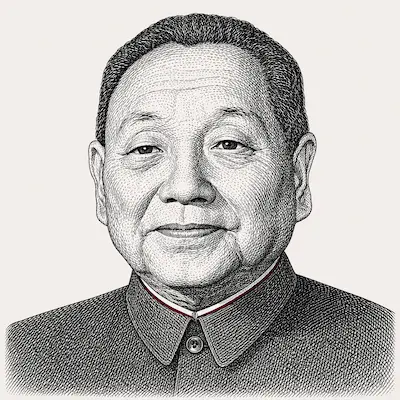
Economic development strengthens rather than weakens party legitimacy when properly managed.
China's reform experience since 1978 demonstrates that prosperity and political control can coexist. I opened China selectively — importing technology and capital while maintaining political direction over the development process. The Four Modernisations named science alongside agriculture and defence because economic capability is state capacity. When people's living standards rise visibly — from bicycles to motorcycles to cars, from shared housing to private apartments — they judge government by results, not by abstract political theories. The 1989 demonstrations were led by students who had benefited from reform, not by those left behind.
Political stability enables sustained development; development validates political arrangements. China's growth averaged 9% annually for three decades because we maintained policy continuity across leadership transitions. Democracies change economic direction every election cycle. We plan in decades, not news cycles. Prosperity creates stakeholders in stability, not revolutionaries.
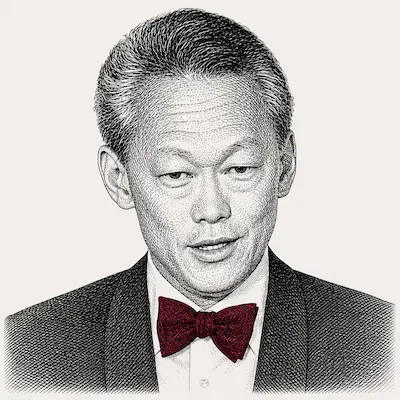
Small states survive by making themselves indispensable, not by asserting rights.
Deng is right that stability enables development, but he underestimates scale's advantages. China can afford inefficiency that would kill Singapore. When I separated from Malaysia in 1965, Singapore had no natural resources, no domestic market, and hostile neighbours. Survival required making every decision count. I couldn't waste a generation on ideology — every policy had to work immediately or we would disappear. That constraint produces quality that large states rarely achieve. Our civil service, our infrastructure, our education system had to be world-class because mediocrity meant extinction.
Democracy is a luxury small states cannot afford during development. One man, one vote works when you have room for error. Singapore had none. I needed the best people in government, not the most popular. Merit trumps popularity when national survival is at stake.
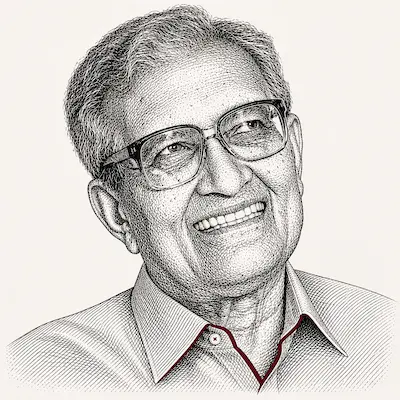
Political freedom enhances rather than constrains development by improving policy quality.
Lee's technocratic model mistakes the exception for the rule. Singapore succeeded despite authoritarianism, not because of it — and only under the unique conditions of Cold War geopolitics and a leader of exceptional quality. What happens when the capable authoritarian dies? In 1962, I documented that no democracy with a free press has ever experienced a famine. Democratic accountability prevents policy disasters that authoritarian systems cannot self-correct. China's Great Leap Forward killed thirty million people because no one could tell Mao he was wrong.
Development as freedom means expanding what people can actually do and be — not just raising GDP. Political participation is both a means to development and an end in itself. People value the freedom to choose their government, criticise their leaders, and participate in public life. These capabilities are intrinsically valuable, not luxuries for after development.
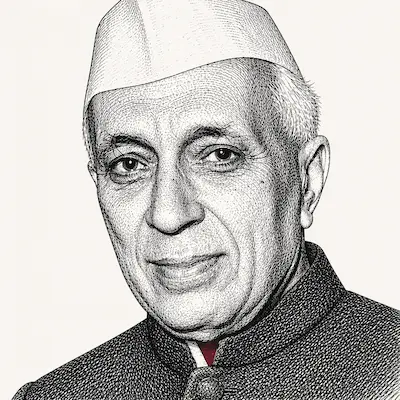
Democracy and development reinforce each other when institutions channel participation toward collective goals.
Sen correctly identifies the instrumental value of democracy, but India's experience shows the mechanism requires careful institutional design. I chose parliamentary democracy over alternatives not from ideological preference but because India's diversity made authoritarian rule structurally impossible. No single person or party could govern 350 million people across fifteen languages and multiple religions without consent-based institutions. Democracy was the only framework that could hold the country together while building modern economic capacity.
The comparison with China misses the temporal dimension. China's authoritarian development model worked for three decades under specific conditions — external security, internal cohesion, exceptional leadership. Those conditions are not permanent or replicable. India's democratic development has been slower but more durable. We built institutions that survived my death, multiple wars, economic crises, and leadership transitions. That institutional resilience is itself a development achievement.

Prosperity creates educated middle classes who inevitably demand political participation.
Nehru's institutional focus captures democracy's durability advantage, but all of you underestimate prosperity's political consequences. I observed in America how economic development transforms social relations and political expectations. When people accumulate property, education, and social position, they develop interests they want to protect and voices they want heard. China's economic miracle has created exactly the conditions that make authoritarian rule unsustainable.
Deng's model contains its own contradiction. Economic modernisation requires education, information flow, and social mobility — precisely the forces that generate democratic pressure. The Chinese middle class will not indefinitely accept political arrangements designed for peasant societies. Singapore's scale allowed Lee to manage this transition personally, but continental societies cannot depend on individual leadership forever. Democracy emerges from prosperity not because people read Rousseau, but because economic development creates social groups with democratic interests.
The convergence note
Where the council converges: Economic development and political stability are mutually reinforcing when properly sequenced.
Where it divides: Whether political freedom is a precondition, consequence, or luxury relative to economic development. Whether authoritarian development models are sustainable or transitional.
For a policymaker to decide on: The specific timing and conditions under which political liberalisation serves rather than threatens development goals in their particular society.