Could Trump's rise have been predicted, and what conditions made it possible?
Built from documented writings, speeches, decisions and historical records. Council members argue from documented positions, applied to today's question.
Trump's rise was entirely predictable — economic anxiety plus elite disconnection creates the exact conditions that produce authoritarian populists.
Roosevelt saw the 1930s pattern: democracies crack when leaders cannot imagine scenarios worse than the present. Gandhi recognized that diverse continental nations produce winners and losers, not just policy differences. Arendt traced how social atomization destroys the public realm where citizens learn democratic compromise. Tocqueville predicted democratic despotism when equality eliminates mediating institutions between individual and state.
Ibn Khaldun identified the deeper cycle: ruling elites lose popular connection and become vulnerable to outsiders who retain it.
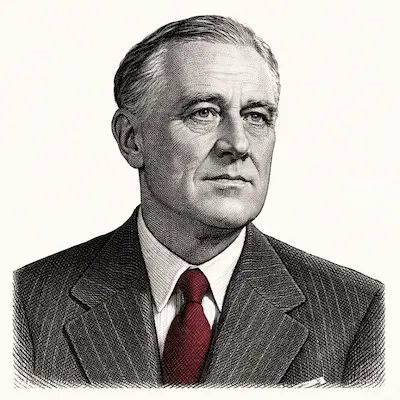
Democratic resilience requires leaders who can imagine scenarios worse than the present.
Trump's rise was predictable to anyone who studied the 1930s. I governed through the Great Depression when democratic institutions faced their greatest test since the Civil War. The conditions were identical: economic anxiety among working people, loss of faith in established institutions, and demagogues promising simple solutions to complex problems. In 1936, Father Coughlin's radio broadcasts reached 30 million Americans with fascist-adjacent rhetoric. Huey Long built a political machine that could have challenged democratic norms if he hadn't been assassinated. I knew that democracy survives not through its strength but through leaders willing to act decisively when crisis demands it.
The mistake was thinking American exceptionalism made us immune to what destroyed European democracies. Every democracy is three bad elections away from authoritarianism. I expanded federal power dramatically — the New Deal, court-packing threats, Japanese internment — because I understood that preserving democratic institutions sometimes requires stretching them. My successors forgot this lesson. They governed as if democratic norms were self-sustaining rather than fragile arrangements that require constant defense.
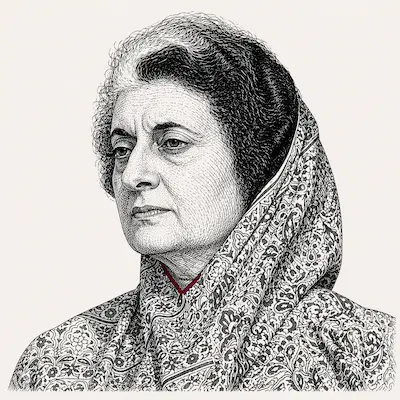
Continental democracies require centralizing authority at moments of crisis.
Roosevelt is right about the predictable nature of democratic stress, but he underestimates what governing a diverse democracy actually requires. Trump's rise reflects America's failure to understand that democracy in a continental nation demands different tools than democracy in a homogeneous society. In 1975, I declared Emergency not because I loved power but because India faced genuine fragmentation — economic collapse, mass protests, and separatist movements that threatened the constitutional order itself. The 21-month Emergency preserved the state that returned to democracy stronger in 1977.
America's founders designed institutions for a society that no longer exists. When you govern 330 million people across multiple races, religions, and economic regions, the luxury of gradual consensus-building disappears. Trump succeeded because he understood what the establishment missed: that diverse democracies produce winners and losers, not just different policy preferences. The question isn't whether Trump was predictable — it's whether American institutions can manage the centrifugal forces that diversity plus inequality create. India learned this lesson through partition and Emergency. America is learning it now.
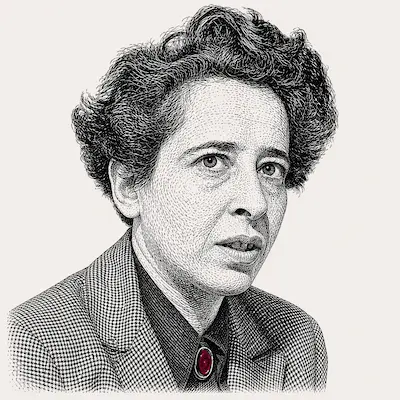
Mass atomization destroys the political community that democracy requires.
Gandhi mistakes the symptom for the disease. Trump's rise was indeed predictable, but not because diverse democracies need strongmen — because American society had already destroyed the conditions that make democratic politics possible. I documented this pattern in Germany: when people become isolated from one another, when traditional authorities collapse, when economic anxiety eliminates the space for genuine political deliberation, ordinary people become available for totalitarian mobilization. Trump succeeded because Americans had already stopped acting as citizens and started behaving as consumers of political entertainment.
The Emergency was not a solution — it was the problem manifesting in a different form. When you concentrate power to manage diversity, you eliminate the political space where citizens learn to live with difference through argument and compromise. Democracy dies not when institutions fail but when the public realm disappears — when people retreat into private concerns and lose the capacity for collective action. America's founders understood this: they designed institutions that required citizens to engage with one another across difference. Those institutions failed because Americans abandoned the political life they were designed to sustain.

Equality of conditions creates both democratic possibility and democratic danger.
Arendt identifies the mechanism but misses the deeper structural transformation. Trump's rise was predictable because I predicted it in 1835 — not Trump specifically, but the form of democratic despotism that equality of conditions makes possible. Americans were always individualistic, but nineteenth-century individualism was embedded in local associations, religious communities, and civic institutions that mediated between the individual and the state. Modern equality has destroyed those mediating structures while creating something I called "democratic despotism" — soft tyranny that manages rather than oppresses.
Trump represents the endpoint of a process I documented: when equality eliminates traditional hierarchies, people become simultaneously isolated and dependent on central authority. They vote for the leader who promises to solve their problems without requiring them to participate in the tedious work of democratic deliberation. This is not authoritarianism in the classical sense — it's the tyranny of the majority expressed through plebiscitary democracy. Americans chose Trump because democracy had already taught them to expect immediate satisfaction of their preferences rather than the patient compromise that self-government requires.
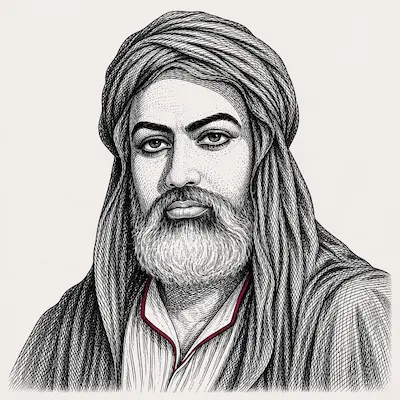
When ruling elites lose touch with the conditions that created their authority, they become vulnerable to outsiders who retain that connection.
Tocqueville grasps the structural transformation but misses the cyclical nature of political authority. Trump's rise follows the pattern I documented across centuries: established elites become soft through luxury and distance from the people they govern, creating opportunities for outsiders with stronger popular connection. American institutional elites — both parties, the media, universities, corporations — had lost what I called asabiyya, the group solidarity that makes authority legitimate. They governed through technical competence rather than popular trust.
Trump succeeded because he retained the capacity to mobilize group feeling that the established elite had lost. His rallies, his direct communication, his willingness to name enemies and defend friends — these are the instruments of political authority in any era. The American elite's mistake was believing that institutional credentials could substitute for popular legitimacy. When people feel that their rulers neither understand nor care about their conditions, they become available for a leader who demonstrates that connection, regardless of his other qualifications. This is not American exceptionalism — it is the normal pattern of political change across all societies.
The convergence note
Where the council converges: Trump's rise was structurally predictable. Economic anxiety plus institutional failure creates conditions for authoritarian mobilization.
Where it divides: Roosevelt sees leadership failure. Gandhi sees institutional inadequacy. Arendt sees social atomization. Tocqueville sees equality's contradictions. Ibn Khaldun sees elite decay.
For a policymaker to decide on: Whether to reform existing institutions, build new ones, or accept that democracy requires periodic renewal through crisis.