Do Trump's policies and approach to government pose a threat to American democratic institutions?
Built from documented writings, speeches, decisions and historical records. Council members argue from documented positions, applied to today's question.
Trump's pressure on courts, prosecutors, and elections is a real threat, but whether institutions hold depends on whether their defenders still act like defenders.
Arendt and Locke converge on the mechanism: personal loyalty replacing institutional judgment hollows out a republic without tanks or a coup. When prosecutors are fired for pursuing disfavored cases, the shell of legality remains while the substance drains. Machiavelli and Ibn Khaldun push back with a structural counter: appointment power does not equal durable control. Borgia controlled the Romagna entirely in 1502 and lost it within months of his patron's death.
Luxemburg names the split the others miss. Formal institutions were already bent toward concentrated wealth before 2016. Defending their form without addressing that prior capture may protect a vessel that many citizens correctly judge as empty.
- 1Strengthen judicial independence by protecting prosecutors from politically motivated dismissal through enforceable civil service rules.
- 2Publish a public account of which democratic norms have been violated and which institutional checks remain operative.
- 3Address concentrated wealth's prior capture of formal institutions; defending institutional form without economic reform protects an empty vessel.
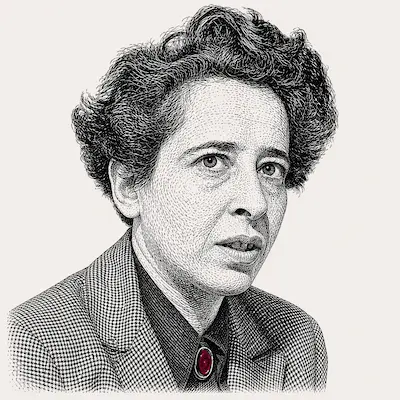
Loyalty to a person, not a law, is how republics die.
The pattern is not new, and I documented it precisely. What destroys a republic is not a dictator who arrives with tanks. It is the slow substitution of personal loyalty for institutional judgment, until the institution itself becomes a shell that performs legality while hollowing it out. I watched this happen in Weimar. The civil service, the judiciary, the press: each capitulated not through force but through a failure of thinking, the same thoughtlessness I observed in Eichmann's dock in Jerusalem in 1961. When federal prosecutors are dismissed for pursuing cases the executive dislikes, when electoral outcomes are declared fraudulent before ballots are counted, the public realm that makes democratic action possible is being dismantled piece by piece.
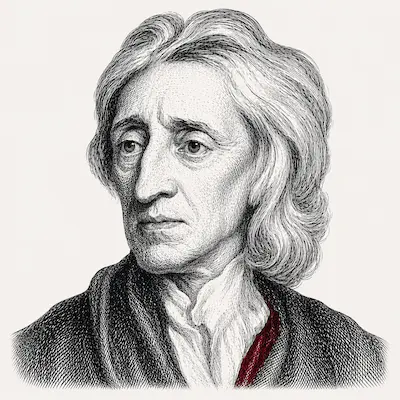
A government that escapes its own law has already broken the compact.
The challenge Arendt poses is one I answered in 1689, and the answer has not changed. Systematic violation, not any single act, is the threshold. In the Second Treatise I wrote that wherever law ends, tyranny begins. The executive's claim to immunity from legal process is not a policy dispute; it is a claim to stand outside the law that constitutes the government's authority in the first place. No subject can be bound by a rule the ruler exempts himself from. When a government delegitimises the courts that constrain it, pressures the legislature that authorises it, and contests the elections that renew its mandate, it dissolves its own claim to obedience. The people do not rebel against such a government. They observe its self-dissolution.
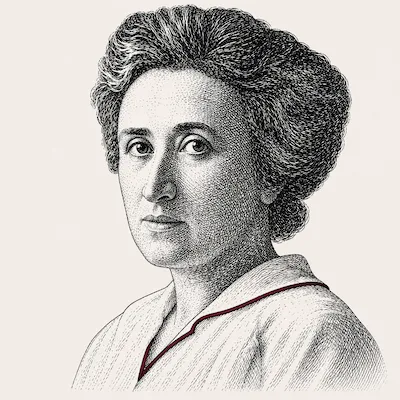
Authoritarian populism grows in the soil that inequality prepares.
Locke's challenge cuts to the bone, and my answer is: no, formal law alone cannot hold. The crisis people are debating now is not an accident or a personality. In 1915 I wrote from a Berlin prison that bourgeois society stands at a crossroads between socialism and barbarism, and the mechanism I identified was this: extreme material inequality coexists with formal political equality until the contradiction becomes unbearable, and then a demagogue steps through the gap. America's Gini coefficient has risen for four decades. Wages stagnated while asset prices soared. The citizens who feel the formal institutions delivered nothing for them are not wrong about the facts; they are misdirected about the remedy. The institutions Locke and Arendt want to defend were already captured by concentrated wealth before Trump arrived. Defending their form without addressing that capture is defending an empty vessel.
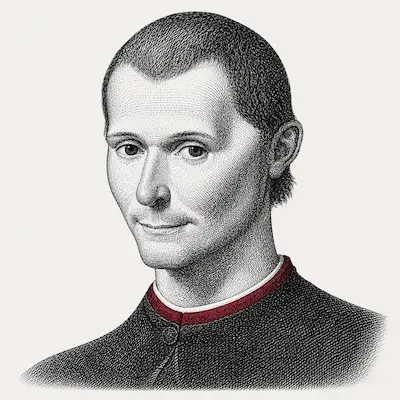
New orders fail because defenders are fierce and beneficiaries are uncertain.
Luxemburg's challenge deserves a precise answer: controlling appointments is not the same as controlling outcomes. I served as Florentine Chancellor and watched Cesare Borgia build what looked like an unbreakable order in the Romagna between 1500 and 1503. When his father Pope Alexander VI died, the entire structure collapsed within months, because Borgia had built personal loyalty, not institutional loyalty. That is the structural weakness every prince who relies on appointments faces: the loyalty he buys expires when his power to reward it expires. American federalism, the independent judiciary, the free press, and the professional civil service are not merely norms. They are entrenched interests with their own survival drives. Luxemburg is right that concentrated wealth shapes institutions, but she underestimates how fiercely those institutions defend themselves once their own existence is threatened.
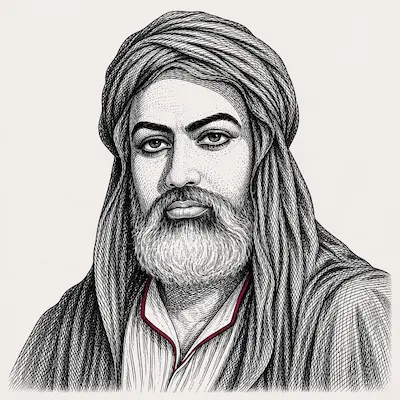
The decisive question is whether the defenders still share a common bond.
Machiavelli's challenge is the right one, and I must apply my framework carefully here, because I built it on North African sultanates, not elected republics. That extrapolation must be stated plainly. But the structure I observed in the Muqaddimah holds: external pressure on a group with strong internal cohesion consolidates it; the same pressure on a group whose cohesion has already eroded accelerates collapse. The diagnostic question for America is not whether Trump violates norms. It is whether the judiciary, the civil service, the military, and the press still share the operative solidarity that makes coordinated resistance possible. In Book III I documented how declining dynasties expand their administrative apparatus while losing coherence, and how tax-base erosion signals dynastic stress. Both are visible. But I also documented that the challenger's asabiyya matters as much as the defender's weakness. A populist movement is not a tribal army. Its cohesion is thinner than it appears.
The convergence note
Where the council converges: The pattern of executive aggrandizement, pressure on judicial independence, and delegitimisation of elections is real and structurally significant. All five members agree the stress is not trivial.
Where it divides: Arendt, Locke, and Luxemburg hold that the preconditions for self-correction are themselves being eroded. Machiavelli and Ibn Khaldun argue that entrenched institutional interests and the challenger's own fragile cohesion create genuine resistance the erosion camp underweights. Luxemburg adds a division the others miss: formal institutions were already compromised by concentrated wealth before the current crisis began.
For a policymaker to decide on: Is the priority defending existing institutions as they stand, or rebuilding the economic conditions that give those institutions popular legitimacy? Choosing the first without the second may preserve the form while losing the substance.