Is the rise of the AfD a threat to German democracy, or a sign that it functions?
- HA
 Hannah
Arendt - AOH
 Albert O.
Hirschman - JR
 Jean-Jacques
Rousseau - KA
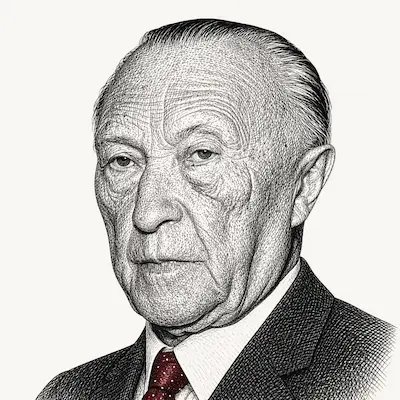 Konrad
Adenauer - IK
 Ibn
Ibn
Khaldun - HS
 Helmut
Schmidt
Built from documented writings, speeches, decisions and historical records. Council members argue from documented positions, applied to today's question.
The AfD's rise is a warning that German democracy is failing its eastern citizens, not proof it is working.
Arendt and Hirschman agree on the mechanism: deindustrialisation after 1990 stripped eastern German towns of jobs, civic institutions, and political voice simultaneously. Voters did not turn to the AfD out of conviction; they turned because mainstream parties stopped showing up. Ibn Khaldun adds the sharpest structural point: the CDU and SPD lost their shared purpose and visible delivery first. The AfD filled the vacuum that collapse left open.
Adenauer argues the Basic Law's militant democracy provisions exist for exactly this moment, and the Constitutional Court review is the system working. Schmidt counters that legal containment without political recovery only postpones the collapse.
- 1Restart visible public investment in eastern German towns, targeting the deindustrialised communities mainstream parties abandoned after 1990.
- 2Require CDU and SPD to publish concrete delivery commitments for eastern Germany, not procedural reassurances.
- 3Run Constitutional Court proceedings under Article 21 in parallel with political recovery, not as a substitute for it.
AfD votes are not the disease; atomised citizens are.
Germany's Basic Law was designed to prevent what I documented in 1951: the transformation of politically homeless, economically displaced people into raw material for movements that promise belonging through exclusion. The AfD's electoral growth follows exactly that pattern. Eastern German deindustrialisation did not produce angry voters; it produced atomised ones, stripped of the civic associations and shared institutions that make political participation meaningful. Electoral success in that context is not democracy functioning. It is democracy's warning signal.
Citizens chose AfD when the cost of internal reform exceeded the cost of exit.
Arendt is right that atomisation matters, but the exit-voice mechanism explains what happened next. When mainstream parties abandoned the political centre on identity, belonging, and economic security, the citizens most capable of reforming those parties from within chose AfD as a protest vehicle instead. That is voice through the wrong channel, which is precisely what happens when exit costs inside the mainstream feel higher than exit costs outside it. In 1970 I documented this failure mode: the most reforming members leave, and the institution decays faster.
Severe inequality destroys the shared identity that democratic legitimacy requires.
Economic inequality does not merely produce resentment; it destroys the shared identity that democratic legitimacy requires. Hirschman's exit mechanism is real, but it describes the symptom. The AfD claims to speak for "das Volk" against a corrupt elite, and this is precisely the move I warned against in 1762: the general will rhetoric weaponised by a particular faction. When inequality grows severe enough, citizens stop identifying with the common good and start identifying with their wound. That produces not democratic voice but democratic pathology.
A democracy that cannot defend itself will not survive its enemies.
Rousseau describes the social failure. I built the institutional response. Germany's Basic Law was not an accident; I designed it with colleagues in 1949 knowing exactly what democratic collapse looked like, because we had lived through it. Article 21 on party prohibition and the concept of streitbare Demokratie, militant democracy, exist precisely for this moment. A democracy that cannot defend itself against parties seeking to dismantle it is not tolerant; it is negligent. The Federal Constitutional Court's ongoing review of the AfD is the Basic Law working as intended.
Ruling coalitions collapse when their internal solidarity visibly disintegrates.
Adenauer's institutions are real, but they cannot substitute for what has already been lost. Extrapolating from the structural analysis I developed in the Muqaddimah, the AfD's rise reflects something the Basic Law cannot address: the CDU and SPD coalition's internal asabiyya has collapsed. A ruling group that governed through solidarity, shared purpose, and visible delivery lost all three. Eastern German communities watched deindustrialisation strip their economic base while Berlin administrations offered procedural reassurance. A new group with stronger internal cohesion always fills that vacuum. Constitutional courts do not reverse that cycle; only recovered solidarity does.
Mainstream parties lost eastern Germany by refusing to speak plainly.
They ceded the ground. In October 2010 I said publicly that multicultural society had failed in Germany, and I was wrong to frame it that way; those words were subsequently used by people I would not have chosen as allies. But the underlying political failure I was pointing at was real. Mainstream parties stopped speaking plainly about belonging, integration, and the limits of tolerance, because plain speech felt dangerous. That silence created space the AfD occupied. The correct response now is not suppression but recovery: reclaim the political centre, speak directly, and deliver visible results in the communities that have been written off.
The convergence note
Where the council converges: The AfD's rise reflects a real failure by mainstream institutions, not a healthy democratic signal. Eastern deindustrialisation, political abandonment, and the collapse of civic association created the conditions for it.
Where it divides: Adenauer and Arendt emphasise institutional and legal containment; Schmidt and Ibn Khaldun argue that containment without political recovery only delays the problem. Rousseau and Hirschman locate the root cause in economic inequality and the collapse of solidarity, which constitutional design cannot repair on its own.
For a policymaker to decide on: Whether to pursue AfD prohibition proceedings under Article 21 now, or to invest in recovering the political centre in eastern Germany first, and whether those two strategies can run simultaneously without one undermining the other.