Is Europe experiencing democratic backslide, and does a rightward shift among governments pose a problem?
Built from documented writings, speeches, decisions and historical records. Council members argue from those positions, applied to today's question.
Europe's rightward shift represents democratic choice exercised against democratic norms.
Arendt and Adenauer agree that Hungary's institutional capture follows documented authoritarian patterns. Schmidt and Locke counter that electoral victories demonstrate consent, not coercion. The EU's stalled Article 7 procedures prove institutions cannot constrain determined bad actors.
The council splits on whether accommodation or resistance preserves democracy when voters choose anti-democratic parties.
- 1Enforce Article 7 procedures against Hungary through qualified majority voting, removing unanimity requirements that enable institutional capture.
- 2Anchor EU funding to measurable rule-of-law benchmarks that member states cannot circumvent through legal technicalities.
- 3Define clear exit mechanisms for members who systematically reject European democratic values while claiming EU benefits.
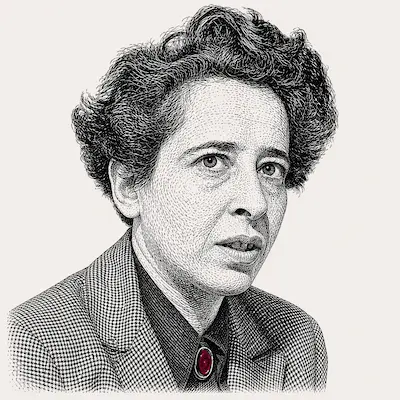
Europe's rightward shift follows totalitarianism's documented playbook.
Hungary's two-thirds majority since 2010 and Germany's AfD breakthrough in Thuringia represent more than electoral shifts. They follow the pattern I documented in 1951: the systematic erosion of pluralism through legal means. Orbán's media control, judicial capture, and NGO restrictions create what I called "rule by nobody", bureaucratic domination that eliminates accountability while maintaining democratic forms. The EU's inability to enforce Article 7 proves that institutions designed for good faith cannot constrain bad faith actors.
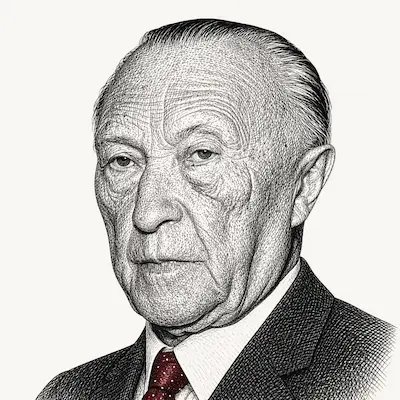
European institutions were designed precisely for this test.
Arendt underestimates what we built. In 1963 I signed the Élysée Treaty with de Gaulle because reconciliation required binding France and Germany together so tightly that backsliding would be structurally impossible. Hungary's Fidesz and Germany's AfD represent the same nationalist forces we faced in the 1950s. The difference is that European integration now makes their success self-limiting. Orbán can capture Hungarian institutions, but he cannot capture European ones. The EU's economic leverage will eventually force compliance or exit.

Democratic institutions are stronger than their critics assume.
Adenauer built well, but Germany won't lead a crusade against democratically elected governments. In 1977 I governed through the German Autumn without suspending democratic norms, even under terrorist pressure. Today's rightward shift reflects economic anxiety and cultural displacement, not institutional collapse. Meloni's Italy maintains NATO and EU alignment. Hungary's economy depends on German investment. These are normal democratic adjustments to real problems. The greater danger comes from overreaction that delegitimizes the electoral outcomes we claim to defend.
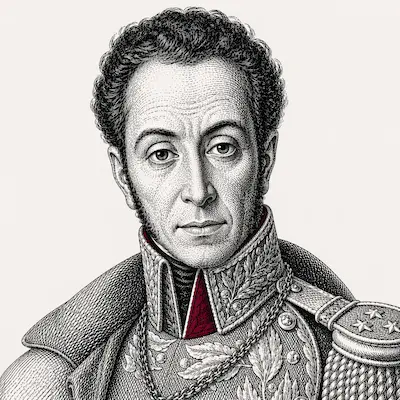
Diverse societies fragment when external pressure mounts.
Schmidt mistakes the symptoms for the disease. In 1828 I watched Gran Colombia tear itself apart despite shared language, religion, and recent liberation. Europe faces deeper divisions: twenty-seven languages, different economic interests, and no shared political culture. Hungary's defiance and Germany's AfD rise signal the same pattern I witnessed: when economic stress combines with cultural anxiety, federal structures become targets, not solutions. The EU lacks the coercive power to enforce unity and the democratic legitimacy to demand it.
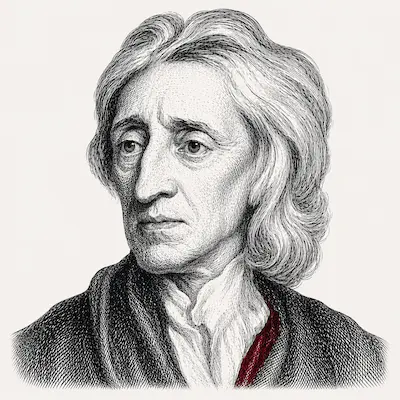
Electoral success demonstrates consent, not its absence.
Bolívar confuses institutional failure with democratic choice. Hungary's Fidesz won repeated elections with clear majorities. Germany's AfD gained support through legitimate political participation. My framework in the Second Treatise is clear: governments derive authority from the consent of the governed. When people vote for parties that restrict NGOs or challenge EU authority, they exercise the same consent that legitimizes EU membership itself. The contradiction lies not in these electoral outcomes, but in claiming democratic legitimacy while rejecting democratic results.
The convergence note
Where the council converges: Europe faces genuine democratic stress from economic anxiety and cultural displacement. Current institutions lack effective enforcement mechanisms against determined bad-faith actors.
Where it divides: Whether rightward electoral gains represent normal democratic adjustment or systematic erosion requiring institutional resistance. Whether European integration strengthens or weakens under nationalist pressure.
For a policymaker to decide on: Whether to treat Hungary and AfD as legitimate democratic outcomes requiring accommodation or as threats requiring isolation and enforcement.