Built from documented writings, speeches, decisions and historical records. Council members argue from documented positions, applied to today's question.
Military force would be strategically catastrophic for China, destroying decades of economic development while failing to achieve sustainable control over Taiwan.
Deng emphasizes that war would reverse China's successful integration strategy and trigger devastating sanctions, while Lee warns it would force Asian neighbors into opposing alliances. Ben-Gurion distinguishes this from survival-driven military action, noting Taiwan poses no existential threat to China, and Schmidt highlights the incalculable risk of nuclear escalation with the United States.
The council agrees that patience serves China's interests better than force, though members differ on whether territorial claims or regional strategic costs provide the stronger argument against military action.
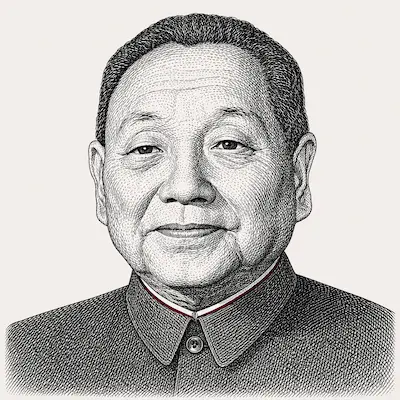
Military action would destroy China's rise and Taiwan's prosperity simultaneously.
I dealt with territorial disputes through gradual, patient strategy. In 1984, I told Margaret Thatcher that Hong Kong would return to Chinese sovereignty, but under "One Country, Two Systems" — preserving Hong Kong's economic dynamism while achieving reunification. This took decades of preparation and negotiation. On Taiwan, I said consistently: "This problem can wait. Time is on our side." Military force would destroy both Taiwan's economic miracle and China's peaceful development strategy.
The costs would be catastrophic. Military action triggers immediate US intervention, devastating international sanctions, and the destruction of Taiwan's advanced semiconductor industry that China needs for its own modernization. More fundamentally, it reverses China's strategic priority. For forty years, we built prosperity through integration with the world economy. War makes China a pariah state, sets back our development by decades, and hands strategic victory to those who want to contain China's rise.
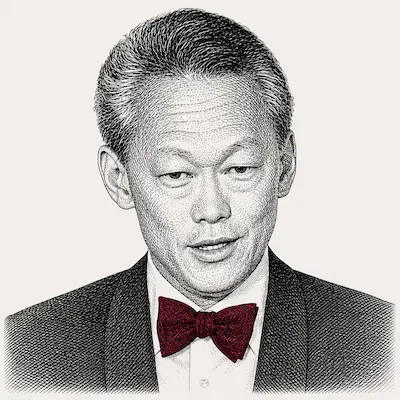
Military action would force every Asian state to choose sides, ultimately weakening China's position.
Deng is correct about the strategic costs, and I add the regional dimension. In 1965, Singapore separated from Malaysia — not by choice, but we made separation work by making ourselves indispensable to multiple powers simultaneously. China's strength in Asia today comes from being every country's largest trading partner without being their military threat. Military action against Taiwan destroys this careful balance overnight.
The moment Chinese forces cross the Taiwan Strait, every Southeast Asian government faces an impossible choice: side with China and lose American security guarantees, or side with America and face Chinese economic retaliation. This fractures ASEAN, militarizes the South China Sea, and forces regional states into American arms. China becomes surrounded by hostile alliances instead of neutral trading partners. The region that enables China's rise becomes the region that contains it.
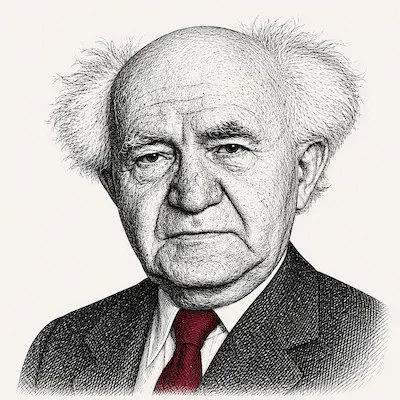
Military action succeeds only when it solves a problem that cannot be solved otherwise, and when you can live with all the consequences.
Lee correctly identifies the strategic environment question. In 1967, Israel faced immediate existential threat — Arab armies mobilizing, Egypt closing the Straits of Tiran, Soviet weapons flowing to our enemies. The Six-Day War was not about territorial ambition but about survival. We succeeded because we achieved clear objectives rapidly and because delay meant destruction.
China faces no equivalent threat from Taiwan. Taiwan does not threaten China's existence — it threatens China's pride and territorial completeness. These are not the same thing. Military action that serves pride rather than survival typically produces consequences the initiator cannot control. Israel's experience also shows that military victory without political resolution creates permanent occupation costs. China would face governing 23 million hostile Taiwanese while managing American military response and global economic isolation — a strategic burden that undermines rather than advances Chinese power.

The risk of miscalculation exceeds any conceivable benefit, and irreversible decisions require the highest burden of justification.
Ben-Gurion frames this correctly as a calculation problem, and I add the nuclear dimension that makes this calculation impossible to get right. In 1979, I supported NATO's dual-track decision on intermediate-range nuclear forces precisely because uncertainty about Soviet intentions required insurance against worst-case scenarios. Today, China faces the same uncertainty about American nuclear response to Taiwan invasion.
The United States has strategic ambiguity about Taiwan defense, but tactical nuclear weapons in the region and alliance commitments that could trigger escalation. No Chinese planner can reliably calculate whether limited American involvement becomes unlimited American involvement. Once nuclear powers are shooting at each other over Taiwan, the situation escapes both sides' control. The 1962 Cuban Missile Crisis showed how quickly great powers can stumble into apocalyptic confrontation.
Military action against Taiwan is an irreversible decision taken under irreducible uncertainty about nuclear escalation. Such decisions require justification by existential necessity. China's territorial claims on Taiwan, however legitimate historically, do not meet that threshold. The prudent strategy is patience.
The convergence note
Where the council converges All members agree that military action would be economically catastrophic for both China and Taiwan, would trigger massive international opposition including likely U.S. military intervention, and would undermine rather than advance China's long-term strategic interests in the region.
Where it divides The division is between those who see Taiwan as a legitimate but non-urgent territorial claim that can wait for political solutions (Deng, Schmidt) and those who focus on the strategic costs of regional destabilization and alliance formation that would permanently damage China's position (Lee, Ben-Gurion).
For a policymaker to decide on Whether Chinese territorial integrity and national dignity justify accepting the documented risks of military failure, nuclear escalation, economic devastation, and permanent regional hostility — a judgment that depends on how Chinese leadership weighs pride versus prosperity, immediate satisfaction versus long-term strategic advantage.