The Long Council
Who was selected, and why
Is AI going to kill us all?
The central tension
Should AI be governed as a civilisation-level emergency or as a serious but manageable risk like other powerful technologies?
The two poles
Precautionary emergency governance
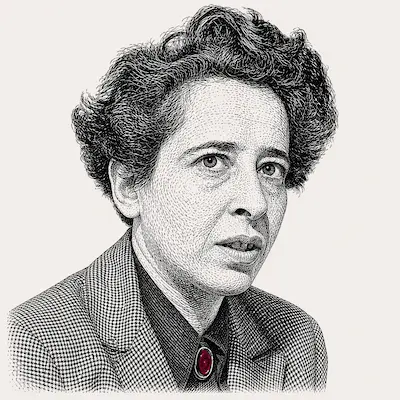 Hannah Arendt
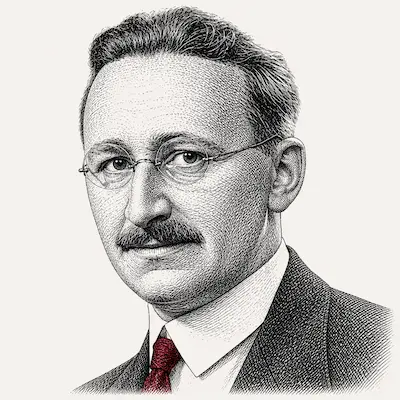 Friedrich Hayek
Proportionate managed-risk oversight
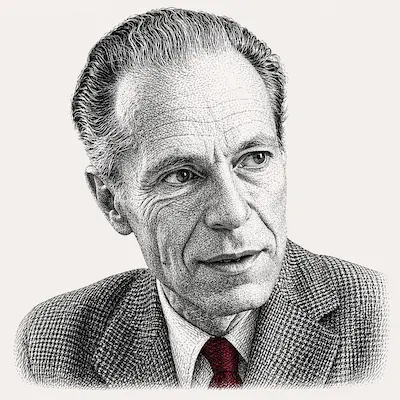 Albert O. Hirschman
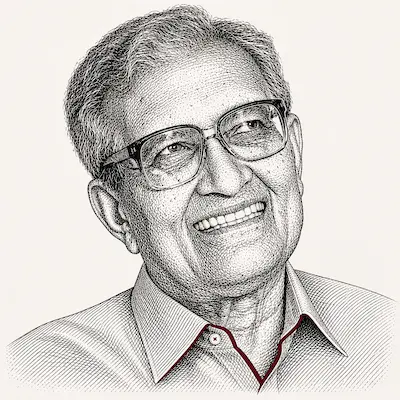 Amartya Sen
Selected members
Hannah Arendt
Will argue: AI systems that make high-stakes decisions without traceable human judgment institutionalise the "rule by nobody" she identified as the most dangerous modern form of domination.
Her documented analysis of how "rule by nobody" in bureaucratic systems eliminates accountability maps directly onto AI governance failures.
Friedrich Hayek
Will argue: Both the AI systems themselves and the governments proposing to govern them are claiming knowledge they structurally cannot possess, making both the technology and its proposed regulation sources of dangerous overconfidence.
His documented knowledge-problem argument, that no central authority can possess the dispersed, tacit knowledge markets aggregate, cuts directly against both AI solutionism and centralised AI control.
Albert O. Hirschman
Will argue: The question is not whether AI is dangerous but which AI decisions are irreversible, and those deserve a qualitatively higher burden of justification before deployment.
His documented irreversibility threshold principle, that permanent decisions require qualitatively higher justification than reversible ones, is the sharpest analytical tool available for evaluating AI deployment decisions.
Amartya Sen
Will argue: The existential risk framing is dominated by the concerns of wealthy, technically sophisticated people, and ignores how AI systems are already foreclosing capabilities for the globally least advantaged through surveillance, labour displacement, and biased allocation systems.
His documented capability approach reframes the question from "will AI kill us" to "what will AI enable or foreclose for the least advantaged", the distributive and freedom dimensions the existential framing obscures.
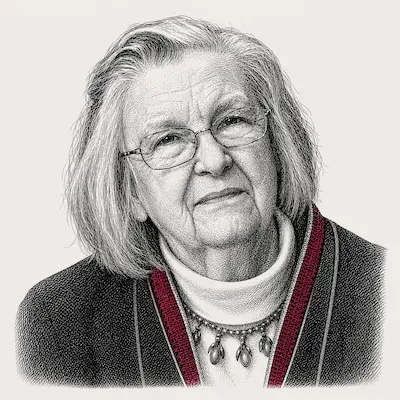
Elinor Ostrom
Will argue: AI governance will fail if designed as either pure market competition or centralised state control, it requires polycentric institutions with clearly defined boundaries, graduated sanctions, and participation by those who will live under the rules.
AI governance is a genuine collective-action and commons-design problem, multiple actors, shared risk, no single authority, and her documented design principles for durable common-pool institutions are the most empirically grounded framework available.
Considered but not selected
Keynes: His documented uncertainty-versus-risk distinction (from the Treatise on Probability, 1921) is genuinely relevant: AI risk is Keynesian uncertainty, not calculable risk, which has strong implications for the precautionary argument. Not selected because Hayek's documented epistemic humility argument covers the uncertainty pole more directly for this question, and adding Keynes would over-populate the precautionary side without adding a distinct line of reasoning.
Eleanor Roosevelt: Her documented framework for translating moral principles into enforceable international law is relevant to AI governance architecture. Not selected because her documented domain is human rights institutions and refugee protection, and the extrapolation required to apply her framework to AI governance specifically is thinner than for the selected members. Ostrom's institutional design framework is more directly applicable.
Arendt with Sun Tzu: Sun Tzu was considered for the geopolitical-competition dimension of AI governance (the US-China race framing). Excluded per standing rule: Sun Tzu is not to be selected for cooperative governance problems, and any serious AI governance framework must address cooperation as well as competition. His selection would have distorted the table toward a purely adversarial framing of a problem that also has deep collective-action dimensions.