The Long Council
Who was selected, and why
Can capitalism survive an AI-driven economy?
The central tension
Everyone agrees AI will cause massive disruption, but can capitalism fix that with better taxes and safety nets, or is the whole system broken?
The two poles
Fix it with better policy
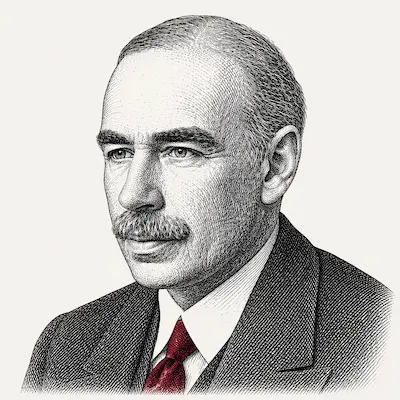 John Maynard Keynes
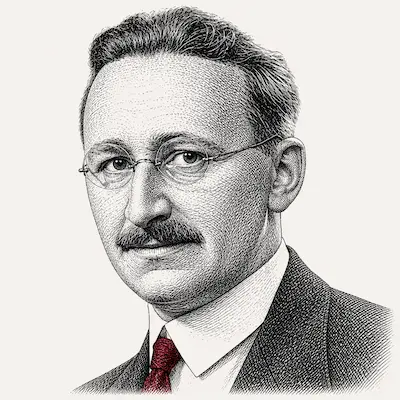 Friedrich Hayek
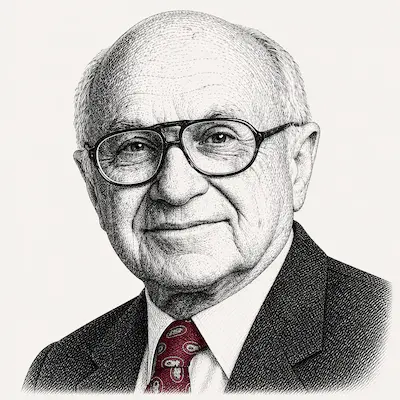 Milton Friedman
The system itself must change
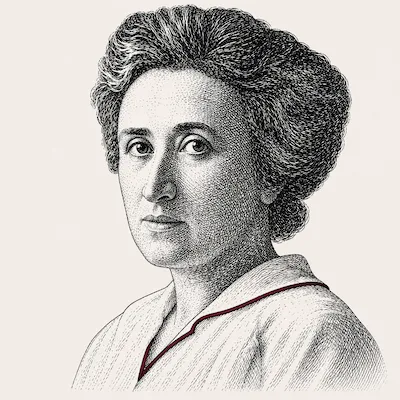 Rosa Luxemburg
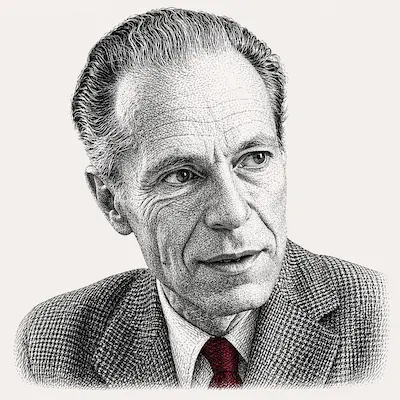 Albert O. Hirschman
Selected members
John Maynard Keynes
Will argue: AI will make us richer but government must redistribute those gains or consumer demand will collapse.
Keynes literally wrote about technology killing jobs and what governments should do about it.
Friedrich Hayek
Will argue: AI tempts governments to think computers can replace markets, and that mistake will be as ruinous as Soviet planning.
Hayek argued that no computer can capture the local knowledge that free market prices already encode.
Milton Friedman
Will argue: Give displaced workers direct cash payments, keep markets free, and resist using AI disruption as an excuse to expand government control.
Friedman proposed the negative income tax, the clearest market-friendly answer to mass job displacement.
Rosa Luxemburg
Will argue: AI wipes out the wages that let workers buy things, and the people who profit from that will block any political fix.
Luxemburg predicted capitalism would collapse once it ran out of new workers and markets to absorb.
Albert O. Hirschman
Will argue: Once AI reshapes the economy it cannot be undone, so societies must demand answers before that lock-in happens, not after.
Hirschman studied irreversible economic changes and how ordinary people lose their ability to push back once a shift is complete.
Considered but not selected
Amartya Sen: directly relevant on the capability dimension (what AI does to what people are able to do and be) and on the democracy-as-epistemic-instrument argument. Not selected because the council already covers the distributional question (Keynes, Friedman), the structural-crisis question (Luxemburg), and the institutional-decay question (Hirschman); Sen's capability framework, while genuinely relevant, would partially duplicate the distributional-reform pole without adding a distinct line of argument. The more urgent gap is on Pole B, and Sen sits closer to Pole A (reformable, through capability investment). He would be the first addition if the session required deeper development-economics grounding.
Elinor Ostrom: initially considered because AI training data, algorithmic infrastructure, and digital commons are plausibly common-pool resources facing collective-action problems analogous to her studied cases. Not selected because the council's selection rules require that Ostrom's commons framework add genuine analytical traction to the central tension, which is about capitalism's systemic viability, not primarily about resource governance. The AI-as-commons framing, while interesting, is a secondary question; her framework would redirect rather than resolve the central debate. She would be the right selection for a session specifically on AI governance architecture or data commons regulation.
John Rawls: his difference principle (inequalities are only justified if they benefit the least advantaged) is a direct analytical tool for evaluating AI-driven inequality. Not selected because his framework is ideal theory operating at the level of principles, and the session's central tension is about the empirical and structural viability of capitalist institutions, not about the normative principles that should govern their design. Rawls provides a benchmark; he does not help answer whether the system can reach it. He would be valuable in a session that has already established the structural question and is now addressing the normative architecture of the successor order.