The Long Council
Who was selected, and why
What conditions and choices made the US economically dominant over 250 years?
The central tension
Did American economic dominance come from free markets and limited government, or from active state direction and structural advantages that markets alone did not create?
The two poles
Markets and liberty
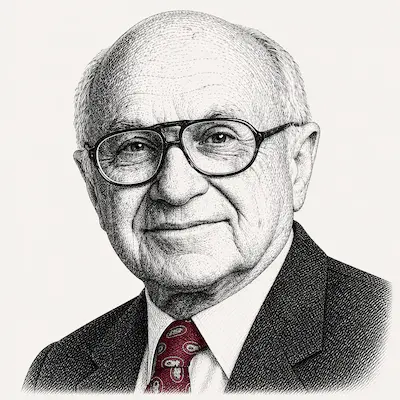 Milton Friedman
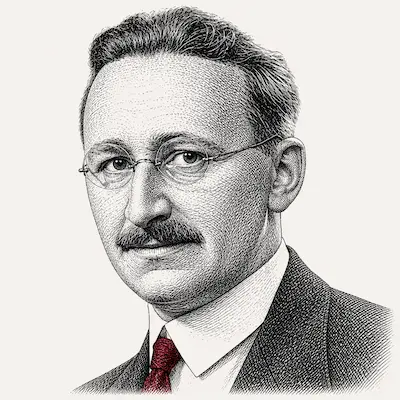 Friedrich Hayek
State direction and institutional architecture
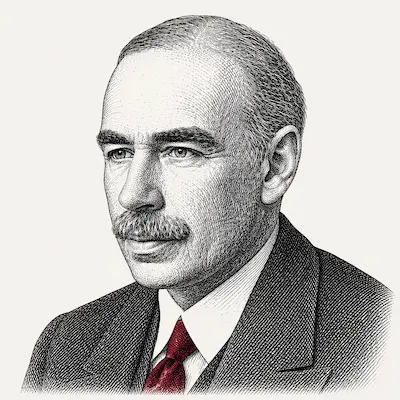 John Maynard Keynes
Hamilton
Selected members
Milton Friedman
Will argue: American dominance rested on price stability, free markets, and the productive energy released when government stopped trying to direct the economy.
His monetary history of the US is the single most documented empirical account of how money supply decisions shaped American economic performance.
Friedrich Hayek
Will argue: America's edge was its dispersed, competitive market order, the moment Washington tried to plan, it introduced the same distortions that crippled rivals.
His knowledge-problem argument explains why decentralised US markets consistently outcompeted state-directed economies across the 20th century.
John Maynard Keynes
Will argue: American dominance was not spontaneous, it required active institutional architecture, wartime fiscal mobilisation, and the deliberate construction of a dollar-centred global order that compounded US advantages for generations.
He designed Bretton Woods, the international monetary order that locked in dollar hegemony and gave the US structural economic advantages no market alone could have built.
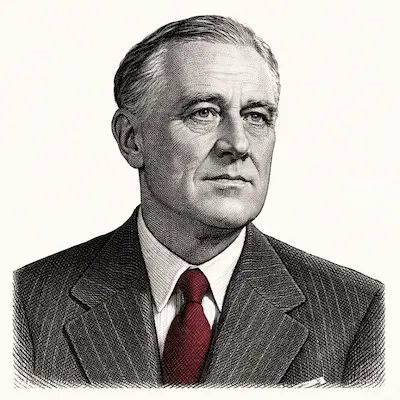
Franklin D. Roosevelt
Will argue: Markets needed saving from themselves in 1933; dominance required government to set the framework, absorb catastrophic risk, and build the international order that private capital alone would never have constructed.
He is the documented practitioner of the state decisions, Social Security, banking reform, wartime mobilisation, Bretton Woods, that turned industrial capacity into durable institutional dominance.
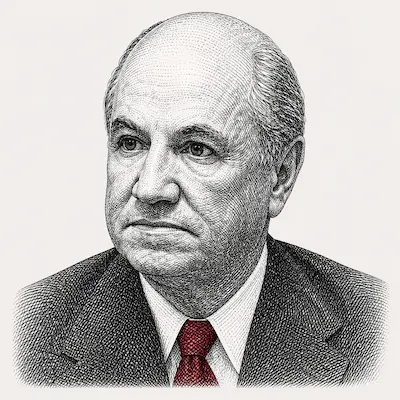
Raúl Prebisch
Will argue: American dominance was not simply the product of superior markets or better policy, it was built into the terms of trade, the Bretton Woods rules, and the GATT framework, which systematically transferred real income from the periphery to the American-led centre.
As the theorist of how the global trading system structurally advantages industrial exporters over commodity exporters, he provides the sharpest external account of why American dominance was partly structural, not purely earned.
Considered but not selected
Amartya Sen: His capability approach would reframe the question toward whether American dominance produced genuine human development, not just wealth. Relevant but the issue asks about the conditions of dominance, not its welfare evaluation, his framework adds important critique but does not sharpen the core causal question. Excluded to avoid diffusing the debate.
Albert O. Hirschman: His development economics and unbalanced growth thesis are relevant to US industrialisation, and his exit/voice framework applies to how American institutions self-corrected. However, his most documented work concerns developing countries, and his addition would overlap with Prebisch's structural critique without adding a distinct pole. Excluded on distinctiveness grounds.
Elinor Ostrom: The question does not genuinely turn on common-pool resources or collective-action design at the institutional micro-level. Excluded per selection rule for specialist framework.