Built from documented writings, speeches, decisions and historical records. Council members argue from those positions, applied to today's question.
Nigeria faces a fundamental choice between accepting Bitcoin's volatility to gain monetary independence from dollar-dominated reserves, or prioritizing institutional stability while remaining exposed to Western monetary policy decisions.
Deng advocates experimental pilot allocation to test Bitcoin's behavior under Nigerian conditions, while Friedman supports gradual adoption after establishing sound domestic monetary institutions. Lee warns that Bitcoin's extreme volatility would destabilize budget planning when Nigeria needs predictable resources for development. Mahathir counters that Bitcoin offers protection from currency speculation and Federal Reserve decisions that serve American rather than Nigerian interests, while Prebisch argues Bitcoin reproduces center-periphery dependency through technological concentration in wealthy countries.
The split turns on whether Bitcoin's promise of monetary sovereignty outweighs its volatility risks for a developing, oil-dependent economy.

Strategic Bitcoin reserves require experimental validation before national commitment — start small, measure results.
When China opened special economic zones in 1979, we tested market mechanisms in four cities before scaling nationally. Nigeria faces a similar strategic choice with Bitcoin. My experience managing China's foreign exchange reserves during the reform era teaches that monetary experiments must be contained until their behavior in your specific economic context becomes clear. Begin with a modest pilot allocation — perhaps 2-3% of reserves — to study Bitcoin's correlation with your naira, oil revenues, and inflation patterns.
The deeper principle is that new financial instruments, like new economic policies, must prove themselves through practice before theoretical commitment. Your oil-dependent economy faces the same foreign exchange volatility we faced during reform. Bitcoin's advocates claim it hedges against dollar debasement, but this requires verification under Nigerian conditions, not abstract argument.

Bitcoin's extreme volatility makes it unsuitable for countries requiring reliable fiscal foundations.
Xiaoping's experimental approach has merit, but he underestimates the risks for a developing economy like Nigeria. When I designed Singapore's Central Provident Fund and managed our foreign reserves through multiple crises, the principle was clear: a small state cannot afford financial instruments that amplify external shocks. Nigeria's fiscal position depends on oil revenues and faces chronic infrastructure deficits. Bitcoin's 50-80% annual volatility would destabilize budget planning precisely when Nigeria needs predictable resources for development priorities.
Our experience with currency attacks in 1997-98 demonstrates that developing countries must build monetary stability before experimenting with speculative assets. Nigeria's institutions — central bank capacity, financial supervision, corruption control — remain works in progress. Adding Bitcoin reserves before these foundations are solid invites unnecessary risk for unproven benefits.
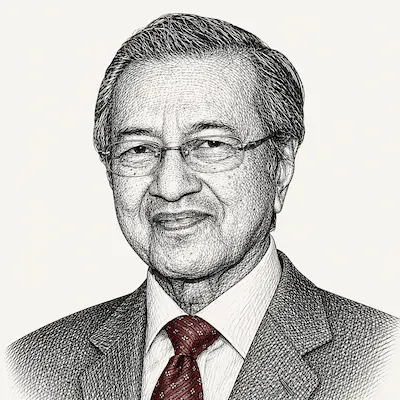
Bitcoin represents monetary independence from Western financial manipulation — exactly what developing nations need.
Lee misunderstands the strategic opportunity. When I imposed capital controls during the 1997 Asian financial crisis, against IMF advice and international pressure, Malaysia recovered faster than countries following orthodox prescriptions. Bitcoin offers Nigeria what we achieved through fixed exchange rates: protection from currency speculation and Western monetary dominance. Nigeria's oil revenues are priced in dollars, making them vulnerable to Federal Reserve decisions that serve American interests, not Nigerian ones.
Bitcoin is not just an asset — it's monetary sovereignty in digital form. When George Soros and currency speculators attacked Asian currencies in 1997, we learned that developing countries need alternatives to dollar dependence. Nigeria establishing Bitcoin reserves signals that African economies will no longer accept monetary colonialism through the dollar system and IMF conditionality.

Bitcoin represents sound money principles but requires gradual adoption alongside institutional monetary reforms.
Mahathir correctly identifies Bitcoin's appeal as a hedge against monetary debasement — my analysis of inflation as a monetary phenomenon supports his concern about Federal Reserve policy affecting Nigerian purchasing power. However, his dismissal of volatility risks ignores the fundamental lesson from our Chilean experiments with rapid liberalization: the pace of reform matters as much as the direction. Nigeria adopting Bitcoin reserves without first establishing sound domestic monetary institutions repeats the sequencing errors we documented in multiple Latin American cases.
The deeper principle is that money must serve as a stable unit of account and store of value. Bitcoin's current volatility fails this test, though its scarcity properties address the inflation problem Mahathir identifies. Nigeria should first implement the monetary rule-following I advocated — predictable central bank policy, fiscal discipline — then gradually add Bitcoin as portfolio diversification, not as monetary foundation.

Bitcoin perpetuates center-periphery dependency through technological and wealth concentration rather than challenging it.
Friedman's monetary framework ignores the structural reality I documented in the Prebisch-Singer hypothesis: the global financial system systematically transfers wealth from periphery to center through its basic operations. Bitcoin reproduces this pattern in digital form. The technology is developed and controlled in the United States and China, mining is concentrated in countries with cheap energy, and early adopters in wealthy countries hold the largest positions. Nigeria adopting Bitcoin reserves would increase, not decrease, its dependency on technological and financial centers.
The terms-of-trade deterioration I identified between commodity exporters and manufactured goods producers now operates between countries that create digital assets and those that merely adopt them. Nigeria's structural challenge remains unchanged: how to industrialize and develop technological capability rather than remaining dependent on external financial innovations, whether dollars or Bitcoin, created by more advanced economies.
The convergence note
Where the council converges All members accept that Nigeria faces genuine monetary sovereignty challenges from dollar dependence and requires diversification of its foreign exchange reserves away from complete reliance on traditional assets.
Where it divides The fundamental disagreement is whether Bitcoin's volatility and technological dependency outweigh its potential benefits as a hedge against dollar debasement and Western monetary policy. Deng and Friedman favor gradual experimental adoption, Lee opposes adoption until institutions strengthen, Mahathir sees it as essential monetary independence, while Prebisch views it as reproducing dependency in digital form.
For a policymaker to decide on Whether Nigeria's immediate need for monetary sovereignty and inflation hedging justifies accepting Bitcoin's volatility risks, or whether institutional development and traditional reserve diversification should precede cryptocurrency adoption.