Could the rise of Trump have been predicted before it happened, and what does history tell us about the conditions that made it possible?
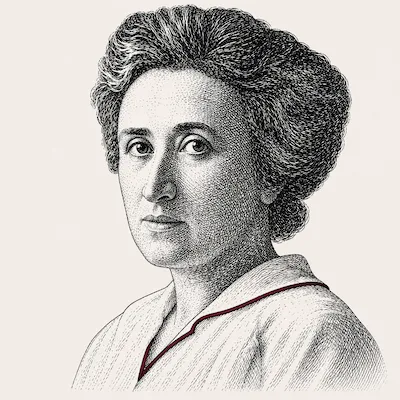
Trump's rise was predictable once American institutions stopped delivering for ordinary people while civic associations collapsed into social media bubbles.
Roosevelt saw that demagogues thrive when democracy becomes a hollow shell serving only elites. Ibn Khaldun identified how America's ruling class had grown soft through unchallenged dominance. Tocqueville traced the atomisation that left citizens isolated and vulnerable to direct manipulation. Arendt showed how conspiracy theories replaced shared facts as the basis for political judgment.
The deeper split is whether this represents a cyclical challenge to failed elites or permanent damage to democratic culture itself.
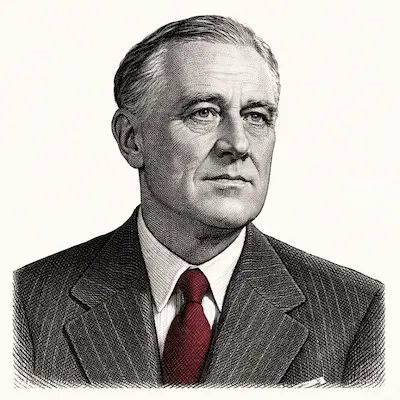
Political survival requires methods suited to the contest, not to an ideal order.
Trump's rise was predictable to anyone who studied the 1930s. In November 1936, I told my cabinet that demagogues thrive when democratic institutions fail to deliver visible results for ordinary people. The choice is not between democracy and authoritarianism — it's between democracy that works and democracy that becomes a hollow shell. When the New Deal put people back to work and gave them hope, Father Coughlin and Huey Long lost their audiences. When institutions serve only elites, they create the conditions authoritarian populists exploit.
The American political system I governed had structural vulnerabilities that Trump activated precisely: the Electoral College that can override popular will, a Senate that represents geography rather than people, and a media environment that rewards sensation over deliberation. These weren't accidents — they were design choices that assumed civic virtue would constrain their abuse. Remove that assumption, and the system becomes what we saw.
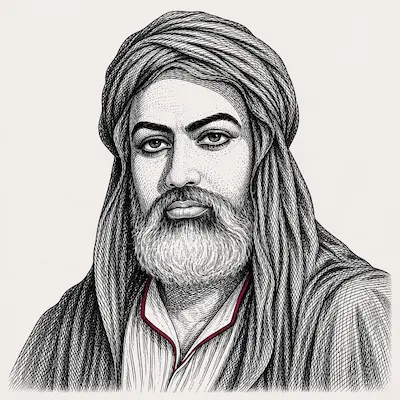
Established elites lose cohesion when luxury erodes the solidarity that enabled their rise.
Roosevelt grasps the institutional vulnerability but misses the underlying dynamic. America's ruling class — the post-war establishment of both parties — had grown soft through decades of unchallenged dominance. They governed through technocratic management rather than popular mobilisation, mistaking process for power. This created the opening Trump exploited. I observed the same pattern in North Africa: when ruling groups lose their asabiyya, they become vulnerable to outsiders who mobilise alternative forms of solidarity.
Trump's coalition combined white working-class resentment with evangelical religious identity — two groups the establishment had neglected or alienated. His asabiyya was real but fragile, built on grievance rather than shared purpose. The 2020 election and January 6th revealed its limits: when tested by actual governance challenges, it fractured. The institutional framework survived because America's constitutional asabiyya — commitment to democratic process — proved stronger than Trump's personal following.

Excessive individualism destroys the civic associations that democracy requires to function.
Ibn Khaldun correctly identifies the elite weakness, but American democratic culture contained structural vulnerabilities I documented in 1835. Democracy's tendency toward individualism — each person retreating into private life — creates what I called "democratic despotism": citizens who are equal but isolated, connected only through their relationship to central power. This is precisely what enabled Trump's direct appeal over the heads of intermediary institutions.
The civic associations I observed — churches, voluntary societies, local governments — had weakened dramatically by 2016. Social media accelerated this atomisation while creating the illusion of connection. Americans increasingly received political information through algorithms designed to confirm their existing beliefs rather than through institutions that required them to encounter different perspectives. The result was a population vulnerable to the kind of majoritarian capture I warned against.
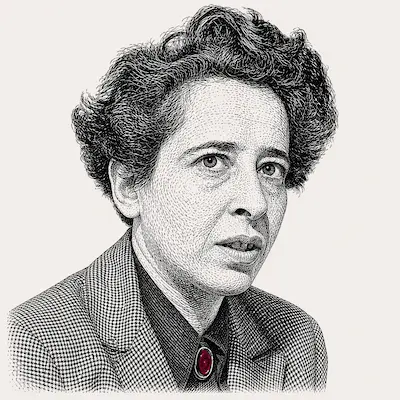
Atomised individuals become the raw material for movements that promise belonging.
Tocqueville identifies the atomisation, but this was more than democratic despotism — it was the emergence of totalitarian preconditions within a democratic framework. Trump's rise required three elements I documented: the destruction of the public realm where citizens engage as equals; the substitution of conspiracy theories for shared facts; and the mobilisation of atomised masses who had lost connection to stable social structures.
The key was not Trump himself but the millions who believed his lies about election fraud despite overwhelming evidence. This represents the collapse of what I called "the human capacity for distinguishing between fact and fiction." When people lose faith in the possibility of shared truth, they become susceptible to narratives that promise to restore meaning and belonging. Trump offered his supporters not just policies but an identity — and identities, unlike policies, cannot be compromised or negotiated.
The convergence note
Where the council converges: Democratic institutions became vulnerable when they stopped delivering visible benefits to ordinary citizens and lost connection to civic life.
Where it divides: Whether Trump represented a cyclical challenge to established elites (Ibn Khaldun) or a structural breakdown of democratic culture (Arendt).
What only the policymaker can resolve: How to rebuild the civic associations and shared institutions that make democratic accountability possible in a fragmented information environment.